Well, the new year is less than two months old, and we're pleased to announce we've already completed one of our New Year's Resolutions. We finally took some time to add some plants around the mailbox, adding a little shot of color to the area.
We had a few challenges to meet, the main one being that the people who owned the house before us had placed lava rock around the mailbox area without putting down landscape fabric underneath. In the intervening years, the lava rock settled down into the soil, making it very difficult to plant in this area without digging up all the rock first... something we didn't really want to have to do. So instead, we used some edging and filled it in with fill dirt and potting soil. Then we added our plants, society garlic and bulbine.
Society Garlic (Tulbaghia violacea) is native to rocky grasslands in South Africa, and thrives in Florida's climate without being invasive. It grows and spreads by rhizome, and after a year or two you can divide and spread it to other areas if you like. It tolerates dry conditions but also withstands our humid summers, as well as withstanding temps as low as 20 degrees.
Society Garlic has a flush of blooms in mid-winter (right around this time) and then off and on throughout the spring and summer. It rests in the winter. The foliage has a strong garlic scent, but the purple flowers themselves are surprisingly sweet-smelling. The bulbs and leaves can be used just like garlic.
Society Garlic mixes well with - and is often planted alongside - Bulbine (Bulbine frutescens), another plant native to South Africa. They thrive in the same conditions and have similar foliage, so they look nice planted together.
Neither of these plants have particularly showy flowers, but their foliage remains green all year round and they'll do well in the dry sunny area by the mailbox. Later this year, we plan to add a flowering vine like thumbergia to climb up the mailbox pole and add some more color. This landscaping may not be exciting or flashy, but it's easy to care for and Florida-Friendly - and we've checked one of our resolutions off the list!
An online journal of our quest to make a tiny piece of Florida suburbia into a wildlife-friendly oasis.
Showing posts with label front yard. Show all posts
Saturday, February 18, 2012
Thursday, April 14, 2011
Iris
The African Iris is beginning to flower close to our front walkway, and they keep slowing me down as I try to head to or from the car - I just have to stop and admire the lovely blooms!
African Iris (Dietes iridioides) is - as you might imagine - native to Africa, where's its generally known as Fortnight Lily, though it really is part of the Iris family (Iridaceae). It blooms starting in spring and periodically throughout the summer, generally with about two weeks (a fortnight) between flushes of blooms. Unlike other irises, flowers appear and reappear on the same stem throughout the season, so don't cut them back after blooming.
In some areas, like Southern California, African Iris is sometime said to be invasive due to is rhizomatus nature and tendency to spread. Here in Florida, that's generally considered an advantage, as the plant can be divided every few years. In fact, that's where we got ours - from a friend who was dividing some. In soil, it seems to grow to best advantage in dappled shade. In water, it can withstand more sun and will grow taller.
The exotic blooms only last a day or two, but come back regularly all summer long, while the green foliage adds nice texture to the landscape. We're always looking for new, interesting, and low-maintenance blooms for the front yard, and African Iris fits the bill well for us.
African Iris (Dietes iridioides) is - as you might imagine - native to Africa, where's its generally known as Fortnight Lily, though it really is part of the Iris family (Iridaceae). It blooms starting in spring and periodically throughout the summer, generally with about two weeks (a fortnight) between flushes of blooms. Unlike other irises, flowers appear and reappear on the same stem throughout the season, so don't cut them back after blooming.
In some areas, like Southern California, African Iris is sometime said to be invasive due to is rhizomatus nature and tendency to spread. Here in Florida, that's generally considered an advantage, as the plant can be divided every few years. In fact, that's where we got ours - from a friend who was dividing some. In soil, it seems to grow to best advantage in dappled shade. In water, it can withstand more sun and will grow taller.
The exotic blooms only last a day or two, but come back regularly all summer long, while the green foliage adds nice texture to the landscape. We're always looking for new, interesting, and low-maintenance blooms for the front yard, and African Iris fits the bill well for us.
Friday, December 24, 2010
Holly Leaves and Christmas Trees
Just in time for Christmas, the holly berries in My Florida Backyard are starting to turn red. Our holly is one of the few plants on the property that was here before we were - it's located on the west side of the house in front of a bedroom window. We feel reasonably sure it is a Burford Holly (Ilex cornuta 'Burfordii'), which is native to Asia. Fortunately, it's not considered invasive in Florida, so we were able to leave this 15-foot shrub in place without any guilt.
Florida has several really great native hollies, including Dahoon Holly (Ilex cassine) and Yaupon Holly, which has the superb Latin name Ilex vomitoria. Given the choice, we would have planted either of these natives instead of the non-native Burford, but beggars can't be choosers. Our holly berries are popular with mockingbirds in the neighborhood - several years ago a male became very territorial in this bush and even began attacking his own reflection in the nearby window to protect his food source. Interestingly, it appears that holly berries actually benefit from cold - they apparently soften and become milder in flavor after a few freezes, making them even more delectable to birds.
Oh, and just for fun, here's a picture of the little live tree we have on the porch in My Florida Backyard. The big (fake) tree is inside, but we just can't resist having a live tree to smell and enjoy during the holidays!
Florida has several really great native hollies, including Dahoon Holly (Ilex cassine) and Yaupon Holly, which has the superb Latin name Ilex vomitoria. Given the choice, we would have planted either of these natives instead of the non-native Burford, but beggars can't be choosers. Our holly berries are popular with mockingbirds in the neighborhood - several years ago a male became very territorial in this bush and even began attacking his own reflection in the nearby window to protect his food source. Interestingly, it appears that holly berries actually benefit from cold - they apparently soften and become milder in flavor after a few freezes, making them even more delectable to birds.
Oh, and just for fun, here's a picture of the little live tree we have on the porch in My Florida Backyard. The big (fake) tree is inside, but we just can't resist having a live tree to smell and enjoy during the holidays!
Thursday, December 23, 2010
Everything's Coming Up Roses
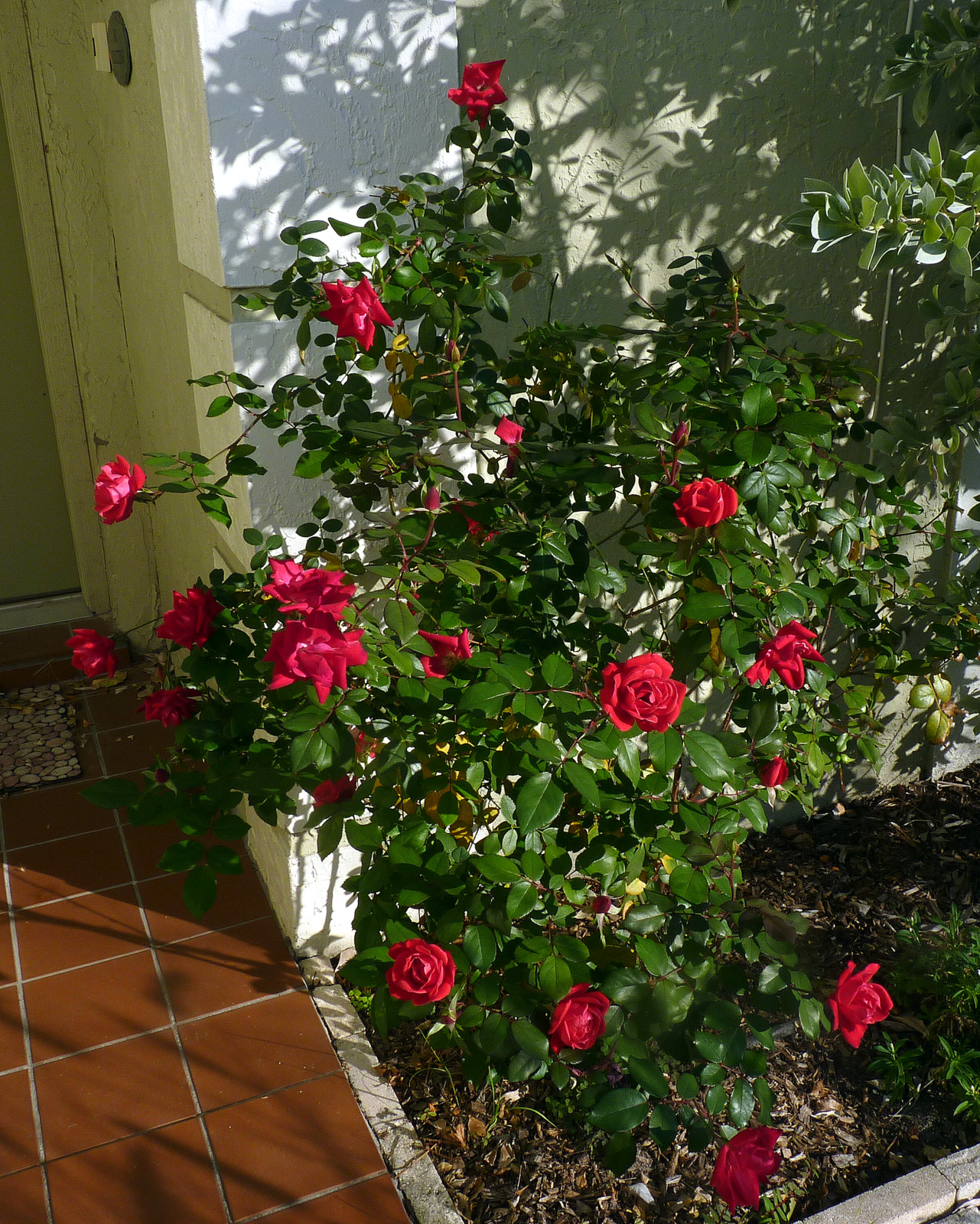
Wow, the Knockout Rose by our front door is happy! Although Knockouts can withstand the heat of a Florida summer, they're much happier when the cooler weather sets in. We gave ours a shot of fertilizer a few weeks ago and covered it during the freeze last week to protect the buds, and it's really paying off!
Oh, and the bees are enjoying it too...
Roses in winter... just one more reason we here in My Florida Backyard couldn't imagine living anywhere else!
Saturday, June 5, 2010
Lo, How a Rose is Growing
Back in March, My Florida Backyard planted its first rose, a pink double Knock Out. We'd been hesitant to plant roses, especially in Florida, because they generally require a great deal of care, and one of our basic rules is to avoid plants that might require excessive pesticides, fungicides, or fertilizer. We were assured, though, that Knockout roses are easy to grow, and it turns out that was certainly true.
By comparing it to the bricks on the wall behind it, you can easily see how much it's grown. By our measurements, it's now about 2.5 feet tall; it was about a foot tall when we planted it. And the growing season is just getting started! Other than some rose fertilizer spikes and the occasional dead-heading, we've done nothing to it, and it looks great. We can certainly add Knock Out roses to our list of Florida-Friendly plants!
The bush to the right of the rose is a Silver Buttonwood (Conocarpus erectus), a really wonderful Florida native with beautiful silver foliage. Our two buttonwoods are planted on the west side of the house where they get a minimum of 6-8 hours of direct sunlight daily. This native is salt-tolerant, so you often see it along beaches and in coastline landscaping.
Buttonwood, unfortunately, doesn't like frost. It's generally considered hardy to Zone 9b. Being close to the house, ours have never shown any damage before, but we all know this past winter was very harsh. One of our buttonwoods took very serious damage and is only just now recovering. Several branches had to be cut off to the ground, but new growth is beginning to show and we expect the bush to rebound. The other took damage to the leaves, but the wood itself seemed to be spared. It has now put out new and beautiful foliage and is doing well.
So, like most everything in a Florida summer, our rose and buttonwoods are growing like crazy. We love to watch life thrive in the summertime in My Florida Backyard!
Here's the rose when planted in early March:
And here it is now:
By comparing it to the bricks on the wall behind it, you can easily see how much it's grown. By our measurements, it's now about 2.5 feet tall; it was about a foot tall when we planted it. And the growing season is just getting started! Other than some rose fertilizer spikes and the occasional dead-heading, we've done nothing to it, and it looks great. We can certainly add Knock Out roses to our list of Florida-Friendly plants!
The bush to the right of the rose is a Silver Buttonwood (Conocarpus erectus), a really wonderful Florida native with beautiful silver foliage. Our two buttonwoods are planted on the west side of the house where they get a minimum of 6-8 hours of direct sunlight daily. This native is salt-tolerant, so you often see it along beaches and in coastline landscaping.
Buttonwood, unfortunately, doesn't like frost. It's generally considered hardy to Zone 9b. Being close to the house, ours have never shown any damage before, but we all know this past winter was very harsh. One of our buttonwoods took very serious damage and is only just now recovering. Several branches had to be cut off to the ground, but new growth is beginning to show and we expect the bush to rebound. The other took damage to the leaves, but the wood itself seemed to be spared. It has now put out new and beautiful foliage and is doing well.
So, like most everything in a Florida summer, our rose and buttonwoods are growing like crazy. We love to watch life thrive in the summertime in My Florida Backyard!
Wednesday, April 14, 2010
That's Good, That's Bad
For several years, My Florida Backyard has been trying to identify the mystery tree in our front yard. This week, we finally succeeded - by following our nose (it always knows!).
It turns out our tree is a Camphor tree (Cinnamomum camphora). While there are plenty of good things about it, there is one major downside - this tree is a Category I invasive tree in the state of Florida. If we were really responsible and dedicated to Florida-Friendly gardening, we'd get rid of it.
But we're not going to.
First, a few facts about the Camphor tree. It's native to East Asia and was brought here to be cultivated for the oil it produces, which has medicinal properties (something you know if you've ever put Campho-Phenique on a mosquito bite or cold sore). Farmers found it wasn't really commercially viable here - the tree only grows half as tall as it does in its native region, and China and Japan had really cornered the market already anyway. The tree gradually shifted to being sold for residential use, and now you'll find some in most neighborhoods throughout the state. It is a deciduous tree, but it does not lose its old leaves until it's already grown new ones, leaving you with a pretty mix of new spring green and older growth dark green leaves for a few weeks, as shown in the picture. At the same time it produces new leaves, it begins to flower, followed by a profusion of black berries later in the year. A very easy way to identify this tree (and one we finally thought to try after several puzzling years) is to crush and smell the leaves - the camphor odor is unmistakable. In the warmer months, it serves as a host plant for the beautiful Spicebush Swallowtail butterfly.
So what's all the fuss about? Camphor tree is very invasive in Florida, which means it has escaped controlled cultivation and is known to be pushing out native plant species needed by our native animals. If you're committed to native Florida gardening, you really shouldn't keep it in your yard - the seeds are easily spread by birds to other areas. According to the Center for Aquatic and Invasive plants, in nearby Polk county the camphor tree is pushing out the native Florida jujube (Ziziphus celatus), relegating it to endangered status. As responsible gardeners trying to make our yard as native as possible, we really should remove this tree.
But... Our tree was probably planted when the house was built, about 25 years ago. It's well-established and provides much-needed shade on the west side of the house. To remove it and plant a new tree would leave an ugly gap that would take many years to fill. Plus, though we've never seen a Spicebush Swallowtail butterfly in My Florida Backyard, it's quite possible they use the upper branches to lay eggs out of sight of the puny humans.
So, we're going to live with the guilt, and with the camphor tree, at least for now.
It turns out our tree is a Camphor tree (Cinnamomum camphora). While there are plenty of good things about it, there is one major downside - this tree is a Category I invasive tree in the state of Florida. If we were really responsible and dedicated to Florida-Friendly gardening, we'd get rid of it.
But we're not going to.
First, a few facts about the Camphor tree. It's native to East Asia and was brought here to be cultivated for the oil it produces, which has medicinal properties (something you know if you've ever put Campho-Phenique on a mosquito bite or cold sore). Farmers found it wasn't really commercially viable here - the tree only grows half as tall as it does in its native region, and China and Japan had really cornered the market already anyway. The tree gradually shifted to being sold for residential use, and now you'll find some in most neighborhoods throughout the state. It is a deciduous tree, but it does not lose its old leaves until it's already grown new ones, leaving you with a pretty mix of new spring green and older growth dark green leaves for a few weeks, as shown in the picture. At the same time it produces new leaves, it begins to flower, followed by a profusion of black berries later in the year. A very easy way to identify this tree (and one we finally thought to try after several puzzling years) is to crush and smell the leaves - the camphor odor is unmistakable. In the warmer months, it serves as a host plant for the beautiful Spicebush Swallowtail butterfly.
So what's all the fuss about? Camphor tree is very invasive in Florida, which means it has escaped controlled cultivation and is known to be pushing out native plant species needed by our native animals. If you're committed to native Florida gardening, you really shouldn't keep it in your yard - the seeds are easily spread by birds to other areas. According to the Center for Aquatic and Invasive plants, in nearby Polk county the camphor tree is pushing out the native Florida jujube (Ziziphus celatus), relegating it to endangered status. As responsible gardeners trying to make our yard as native as possible, we really should remove this tree.
But... Our tree was probably planted when the house was built, about 25 years ago. It's well-established and provides much-needed shade on the west side of the house. To remove it and plant a new tree would leave an ugly gap that would take many years to fill. Plus, though we've never seen a Spicebush Swallowtail butterfly in My Florida Backyard, it's quite possible they use the upper branches to lay eggs out of sight of the puny humans.
So, we're going to live with the guilt, and with the camphor tree, at least for now.
Wednesday, March 31, 2010
Daisy Bell
March went out like a lamb today, providing a great morning for adding plants to the outside edge of our newly-expanded front garden. It's hard to see the new additions in this photo, so see below for close-ups and details.
These cheerful little guys are Dahlberg Daisies (Thymophylla tenuiloba). We found these at our local Lowe's and decided to give them a try, since they love full sun and dry conditions. They are actually a native of South Texas, and grow to about 12 by 12 inches. They may not flower quite as well during the wet heat of our summer, but we're hopeful the well-drained sandy soil in the front yard will provide them with the conditions they need to flourish. The feathery foliage and happy yellow flowers make a nice contrast to plants we alternated them with...
... Purple Queen (Tradescantia pallida), also sometimes called Purple Heart. This native of Mexico caught my eye in the MOSI BioWorks gardens when it began to recover immediately after the hard freeze in January. It tolerates wet or dry conditions and loves full sun, making it a plant that should last for years in the garden.
Our little plants are very small right now, but will grow and spread into a low groundcover around the front edge of the garden. The sunny daisies make a nice contrast to the deep color of the purple queen, and we can't wait to see what they'll both look like after a few months of lots of sunshine!
P.S. Check out the weather forecast for the next week - it's beginning to look a lot like Florida!
These cheerful little guys are Dahlberg Daisies (Thymophylla tenuiloba). We found these at our local Lowe's and decided to give them a try, since they love full sun and dry conditions. They are actually a native of South Texas, and grow to about 12 by 12 inches. They may not flower quite as well during the wet heat of our summer, but we're hopeful the well-drained sandy soil in the front yard will provide them with the conditions they need to flourish. The feathery foliage and happy yellow flowers make a nice contrast to plants we alternated them with...
... Purple Queen (Tradescantia pallida), also sometimes called Purple Heart. This native of Mexico caught my eye in the MOSI BioWorks gardens when it began to recover immediately after the hard freeze in January. It tolerates wet or dry conditions and loves full sun, making it a plant that should last for years in the garden.
Our little plants are very small right now, but will grow and spread into a low groundcover around the front edge of the garden. The sunny daisies make a nice contrast to the deep color of the purple queen, and we can't wait to see what they'll both look like after a few months of lots of sunshine!
P.S. Check out the weather forecast for the next week - it's beginning to look a lot like Florida!
Thursday, March 18, 2010
Looking for Space
My Florida Backyard took another step this week toward the goal of eliminating as much boring, fairly useless grass from our front lawn as possible. This gives us more room for interesting plants that can attract wildlife and, quite frankly, look much better than patchy grass.
Now the tantalizing question remains... what to plant in all the new space? We already have a lot of fountain grass and muhly grass lining the walkways, with plumbago bushes on the right side and beach sunflower under the tree. We'd like to continue with more yellows, purples, and blues - we do have some Blazing Star (liatris) bulbs to scatter throughout the new and old beds, so their purple should mix nicely with the purples of the muhly grass in the fall.
Any suggestions? Bear in mind that we have some pretty firm rules about not using supplemental irrigation once a plant is established... it needs to survive on the rain Mother Nature provides (or doesn't). This area faces southwest and gets lots of sun in the hottest part of summer. We'd like some low plants along the edge in front, and higher plants or even a shrub in the middle. We prefer native plants, though we're flexible as long as they're Florida-Friendly, and we really don't like to have to do a lot of maintenance in the front yard. Now, with all these thoughts in mind, what should we put in our newly-expanded garden?
To that end, we decided to expand the front garden from two arcs:
Into one big arc:
Now the tantalizing question remains... what to plant in all the new space? We already have a lot of fountain grass and muhly grass lining the walkways, with plumbago bushes on the right side and beach sunflower under the tree. We'd like to continue with more yellows, purples, and blues - we do have some Blazing Star (liatris) bulbs to scatter throughout the new and old beds, so their purple should mix nicely with the purples of the muhly grass in the fall.
Any suggestions? Bear in mind that we have some pretty firm rules about not using supplemental irrigation once a plant is established... it needs to survive on the rain Mother Nature provides (or doesn't). This area faces southwest and gets lots of sun in the hottest part of summer. We'd like some low plants along the edge in front, and higher plants or even a shrub in the middle. We prefer native plants, though we're flexible as long as they're Florida-Friendly, and we really don't like to have to do a lot of maintenance in the front yard. Now, with all these thoughts in mind, what should we put in our newly-expanded garden?
Monday, March 15, 2010
La Vie en Rose
My Florida Backyard has a very special visitor right now, a snowbird from up north who finds her way to Florida for two weeks every winter - my mom! She always makes wonderful contributions to the gardens when she's in town, and this year is no exception... My Florida Backyard now has its first roses.
My mother has an amazing rose garden up north in the summer. She babies her roses and they reward her delightfully. She's been urging us to grow roses here for a long time, but I've always resisted, for several reasons. First, roses can find it very hard to deal with Florida's hot and humid summers. Second, roses take a lot of care and specialized knowledge, and I wasn't sure they were a good fit in our mostly native gardens.
So what changed my mind? First of all, a prime piece of sunny real estate became available in my gardens - the croton bush by the front door went kaput in the freeze, and since I've never been that fond of it anyway, we decided to pull it out entirely.
Second, I've become acquainted with the amazing plant called the Knock Out Rose. Fellow gardeners have informed me that this is the rose for people who don't think they can grow roses. It's disease-resistant, heat-tolerant, and almost impossible to kill, even in Florida summers. Perfect!
After removing the old croton bush, we prepped the hole with some bone meal and blood meal, and popped the rose in. We added fresh mulch around the base, but left room for the plant to breathe. We watered it in thoroughly, and voila, our Double Knock Out Rose is in place to welcome visitors!
My mom also bought a couple hybrid tea rose plants for us to try as well. We planted these in the backyard where they can get some dappled shade in the hot summer afternoons. I'll be curious to see how these little fellows fare as the season progresses.
All of gardening is a bit of an experiment... even native plants can sometimes be a challenge. I'm not sure how successful My Florida Backyard will be with its roses, but we look forward to the effort and the possible rewards!
My mother has an amazing rose garden up north in the summer. She babies her roses and they reward her delightfully. She's been urging us to grow roses here for a long time, but I've always resisted, for several reasons. First, roses can find it very hard to deal with Florida's hot and humid summers. Second, roses take a lot of care and specialized knowledge, and I wasn't sure they were a good fit in our mostly native gardens.
So what changed my mind? First of all, a prime piece of sunny real estate became available in my gardens - the croton bush by the front door went kaput in the freeze, and since I've never been that fond of it anyway, we decided to pull it out entirely.
Second, I've become acquainted with the amazing plant called the Knock Out Rose. Fellow gardeners have informed me that this is the rose for people who don't think they can grow roses. It's disease-resistant, heat-tolerant, and almost impossible to kill, even in Florida summers. Perfect!
After removing the old croton bush, we prepped the hole with some bone meal and blood meal, and popped the rose in. We added fresh mulch around the base, but left room for the plant to breathe. We watered it in thoroughly, and voila, our Double Knock Out Rose is in place to welcome visitors!
All of gardening is a bit of an experiment... even native plants can sometimes be a challenge. I'm not sure how successful My Florida Backyard will be with its roses, but we look forward to the effort and the possible rewards!
Friday, February 19, 2010
The Way We Were
I was looking back through some old pictures, and couldn't help missing My Florida Backyard's gardens in their prime. This winter is really dragging on forever, so for now, we just have to enjoy the...
Memories...
Like the corners of my mind.
Misty water-colored memories
Of the way we were.
Tuesday, December 1, 2009
Deck the Halls
Well, we finally found the extension cords, so here are some pictures of the front of the house all decorated for the holidays. Sorry for the picture quality - you need a much better camera than ours to take good night pics.

A note about our lights: My Florida Backyard believes strongly in conservation and the responsible use of resources. In keeping with those ideals, we know we probably shouldn't be "wasting" electricity by putting up several hundred Christmas lights.
We looked into replacing our current lights with energy-saving LEDs, but quite frankly, the cost was prohibitive. I'm really not quite sure why LEDs are so expensive - a string of 100 regular mini-lights costs less than $2, while a string of 100 LEDs costs between $15 and $20. What's the deal?
We often choose the better environmental option in My Florida Backyard, regardless of cost, but we haven't been able to make that commitment yet with our holiday decorations. It's certainly something we'll consider as finances make it possible in the future, and we urge others to research their options and make educated and responsible choices.
P.S. I'm not sure why we bother with lights when Mother Nature puts on such an amazing show in the sky!
(Note the incredibly straight placement of the lights along the gutter.
I have an unnatural abhorrence of "droopy lights".)
We looked into replacing our current lights with energy-saving LEDs, but quite frankly, the cost was prohibitive. I'm really not quite sure why LEDs are so expensive - a string of 100 regular mini-lights costs less than $2, while a string of 100 LEDs costs between $15 and $20. What's the deal?
We often choose the better environmental option in My Florida Backyard, regardless of cost, but we haven't been able to make that commitment yet with our holiday decorations. It's certainly something we'll consider as finances make it possible in the future, and we urge others to research their options and make educated and responsible choices.
P.S. I'm not sure why we bother with lights when Mother Nature puts on such an amazing show in the sky!
Thursday, November 26, 2009
Plenty To Be Thankful For
As the country pauses today to count its blessings, we here in My Florida Backyard are doing the same. It's a lovely day, with warm sun and cool breezes, and soon we'll be eating turkey and mashed potatoes out on our back porch - the part of our home we're most thankful for.
While we eat, no doubt birds will wander by, feasting themselves on the bounty of nature that can be found in My Florida Backyard and the areas nearby - something else to be thankful for.
The sun is drying up the last puddles left by the rain of the last few days - and the rain is yet another thing to be thankful for. November is generally the driest month of the year here, but this month we've had several inches of rain. Both the aquifers and our rain barrel are thankful for that!
It's a little breezy for butterflies today, but caterpillars are still feeding on the passionvine and milkweed, and I'm sure they're thankful we've taken the time to provide them yummy pesticide-free meals!
Perhaps what we're most thankful for, though, is that we live in a land of November flowers. In other places, leaves have fallen off the trees and most flowers are brown and frost-bitten. But in My Florida Backyard, flowers bloom like summer is still here, and we definitely give thanks for that!
While we eat, no doubt birds will wander by, feasting themselves on the bounty of nature that can be found in My Florida Backyard and the areas nearby - something else to be thankful for.
The sun is drying up the last puddles left by the rain of the last few days - and the rain is yet another thing to be thankful for. November is generally the driest month of the year here, but this month we've had several inches of rain. Both the aquifers and our rain barrel are thankful for that!
It's a little breezy for butterflies today, but caterpillars are still feeding on the passionvine and milkweed, and I'm sure they're thankful we've taken the time to provide them yummy pesticide-free meals!
Perhaps what we're most thankful for, though, is that we live in a land of November flowers. In other places, leaves have fallen off the trees and most flowers are brown and frost-bitten. But in My Florida Backyard, flowers bloom like summer is still here, and we definitely give thanks for that!
Thursday, July 30, 2009
Let the Sunshine In
On my way out to get the mail, I had to stop and admire the beach sunflower I planted in the front yard this spring. We don't spend much time in the front yard, but it is the side of the house most people see, so we try to keep it looking nice with minimal effort. Beach sunflower is a fantastic Florida native that fits the bill perfectly. It works as groundcover in full sun or partial shade, and is incredibly drought-tolerant once established.
I planted it this spring after trying several other plants out under this tree in front. I planted some mondo grass, but it didn't do much of anything. I tried several kinds of annuals, but the heat was just too much, even in shade for part of the day. Finally, I decided to try beach sunflower. Since this plant generally grows directly on sand dunes, I knew it should be able to tolerate hot dry conditions.
Because it's a Florida native, of course it was somewhat difficult to find. Fortunately, all the native plant nurseries in the area carry it pretty reliably. I bought mine at Wilcox Nursery in Largo, my favorite place for native plants. We planted four plants under the tree, facing west, back in March. They were watered in and established within about 3 weeks, and since then, I haven't done anything to them. They just grow and bloom and grow and bloom!
We also planted one by the mailbox. Personally, I prefer it to the neighbor's marigolds, but I suppose some prefer a more "manicured" look.
Note that these plants have a spread of 2-3 feet in all directions. Again, that's one plant by the mailbox. This is a true groundcover - one plant will spread to fill in space where you need it.
It does seem to draw some butterflies; I saw a Horace's Duskywing visiting it one day. Since it's in the front yard, where we don't spend much time, it's quite likely that other butterflies visit when we're not looking.
Although I prefer to be in My Florida Backyard, I like knowing that I can keep the front yard looking friendly and cheerful with plants like beach sunflower.
P.S. Just to remind you how much Gulf Fritillary caterpillars love passionvine, check out all the little guys competing for food on this one leaf! (Gee, I wonder who's gonna win?)
Wednesday, March 4, 2009
Ch-Ch-Ch-Ch-Changes...
It's a simply glorious early March day here in Tampa, the kind of day where you know that folks up North are happy to reach into the upper 30s and 40s while we're enjoying warm sun, cool breezes, and temps in the mid 70s. I spent the afternoon puttering around in the gardens, pulling weeds, tying up honeysuckle, and so on, and as I worked, I couldn't help but think how different things are here than they were a year ago.
In my last post, I showed some "before" pictures and talked about the plans we made as we started our landscaping projects. In future posts, I'll detail the work involved in making things happen, but for today, I'm going to show the evolution of our front gardens to make one simple point - gardening is a never-ending experiment.
As a reminder, here's the front yard a year ago, in early March 2008:

Here's the same front yard today, March 2009:

And another view:

While these aren't the best pictures for seeing detail, they do give an overall view of the changes. Here's what's currently thriving in my west-facing front gardens:
I also have some newly planted Beach Sunflowers* that I'm hoping will take off, and several plants that aren't exactly thriving but are slowly finding their way: a Croton bush, a Tropical Hibiscus, and a Pygmy Date Palm. My Lantana Camara has been pruned way back to keep it from overgrowing its welcome (this species is not native and can be invasive if you're not careful, but oh, how it attracts the butterflies!).
Over the last year, these gardens have actually changed several times, as I learned what did and didn't work in My Florida Backyard.
Here are the front gardens after we first planted them in late March/early April 2008:


And here's what we had in mid-July 2008, after a few months of growth and the start of the rainy season (never underestimate the power of a tropical climate to make things grow!):


Sharp eyes will notice that there have been some plant changes since then! Here's what eventually didn't work out in these west-facing front gardens, for one reason or another:

Again, sharp eyes will notice that we desperately needed to do some weeding, but summertime in Florida is really not gardening time. About 10 minutes outside (and that includes mornings and evenings) is about all you can stand, so we let things get a bit overgrown until the weather had cooled down. At any rate, you can see that the Muhly grass offers fantastic rewards in the fall, which I really hadn't expected.
Since that day in October, we have refreshed the mulch and weeded quite a bit. I am also trying the Beach Sunflowers under the tree now and am eager to see how it will do (it's only been in the ground 10 days but already has some flowers). We are in the "peak of the dry", as Steve Irwin would have said, so my plants will grow slowly over the next few months.
All in all, I can't help but feel pleased with our accomplishments. I've learned a lot about what I can and can't grow over the last year, and I look forward to seeing how the right plants will continue to thrive as the next year passes. The experiment continues!
(*Asterisks indicate plants native to Florida. Watch future posts for more info on Native Florida plants.*)
In my last post, I showed some "before" pictures and talked about the plans we made as we started our landscaping projects. In future posts, I'll detail the work involved in making things happen, but for today, I'm going to show the evolution of our front gardens to make one simple point - gardening is a never-ending experiment.
As a reminder, here's the front yard a year ago, in early March 2008:
Here's the same front yard today, March 2009:
And another view:
While these aren't the best pictures for seeing detail, they do give an overall view of the changes. Here's what's currently thriving in my west-facing front gardens:
I also have some newly planted Beach Sunflowers* that I'm hoping will take off, and several plants that aren't exactly thriving but are slowly finding their way: a Croton bush, a Tropical Hibiscus, and a Pygmy Date Palm. My Lantana Camara has been pruned way back to keep it from overgrowing its welcome (this species is not native and can be invasive if you're not careful, but oh, how it attracts the butterflies!).
Over the last year, these gardens have actually changed several times, as I learned what did and didn't work in My Florida Backyard.
Here are the front gardens after we first planted them in late March/early April 2008:
And here's what we had in mid-July 2008, after a few months of growth and the start of the rainy season (never underestimate the power of a tropical climate to make things grow!):
Sharp eyes will notice that there have been some plant changes since then! Here's what eventually didn't work out in these west-facing front gardens, for one reason or another:
- Blue-Eyed Grass* - I don't know what happened with these guys. I absolutely loved them when I found them at the Home Depot nursery(!) and realized they were natives. I planted them all over the place, including in my front gardens, and the were simply gorgeous for about two months. After that, they turned brown and almost seemed to "rot" from the center out. I ended up yanking most of them and replacing them with something else. I still have a few in my back garden, and I'm waiting to see what spring might do for them.
- Oleander - Actually, the oleander in my back gardens is doing all right, if not thriving. I'm hoping the rainy season will bring back the pale pink flowers we had last year. But the one in the front garden just didn't thrive and had to go.
- Mondo Grass - My guess is that these just got too much sunlight in a west-facing garden. This was a case of gardener's error, because I just didn't read the light specification for these plants.
- Saw Palmetto* - Actually, this did fine up front, but the plumbago on either side basically just grew right over top of it. I transplanted this to my back garden, where it continues to limp along. It's a slow-grower and didn't like being transplanted, but it has some new growth and I think will be fine once the warm rainy season arrives.
- Sparkleberry* - Ah, this one broke my heart. This bush was listed in my butterfly gardening book as a great native plant to have, and I was looking forward to the little white flowers it promised. But, alas, it was not to be, because this plant just did very poorly and eventually died. I'm betting it was something I did, but I just don't know what.
Since that day in October, we have refreshed the mulch and weeded quite a bit. I am also trying the Beach Sunflowers under the tree now and am eager to see how it will do (it's only been in the ground 10 days but already has some flowers). We are in the "peak of the dry", as Steve Irwin would have said, so my plants will grow slowly over the next few months.
All in all, I can't help but feel pleased with our accomplishments. I've learned a lot about what I can and can't grow over the last year, and I look forward to seeing how the right plants will continue to thrive as the next year passes. The experiment continues!
(*Asterisks indicate plants native to Florida. Watch future posts for more info on Native Florida plants.*)
Subscribe to:
Posts (Atom)