Showing posts with label wildlife. Show all posts

Friday, April 5, 2013

Fly Like an Eagle (Reprise)

Our eagles have been back again! This time, one of them snagged an enormous fish out of the lake and landed in the neighbor's backyard across the water to subdue it before flying off with it.


Check out the size of the talons on this bird - this picture is overly-zoomed and a little pixelated, but you can really see the power these eagles pack in their feet.


Bald Eagles will eat a lot of things, including roadkill, but they do love a good fish. About they only thing they love more than catching a good fish is stealing one from another bird. In fact, although these birds are mighty hunters, swooping down to catch prey in those enormous talons, they'd rather snatch a fish that someone else has already caught. They're frequently seen grabbing the catch of smaller ospreys right out of the sky. I didn't see if this one did its own fishing, but I can say that the fish in our lake are nesting in the shallow waters at the edge right now, and they would be easy pickings for a bird of this size.


Once this eagle was quite sure the fish was dead, it headed off carrying the fish in its talons, perhaps to share it with a mate. It also may eat the fish all on its own, and then not need to eat again for a few days.


Once again, we can't help but be amazed at the size of that fish. Remember that although Bald Eagles are very big, they don't weigh very much - the largest are about 13 pounds, even with a 6.5 foot wingspan. (Birds have hollow bones to make flight easier.) That fish probably weighed at least half as much as the eagle, but the eagle carried it easily, without a bit of a struggle once the fish was dead. The raw power of these creatures is astonishing.

We're really enjoying the eagle sightings in My Florida Backyard, and hope to continue to have more to share in the days to come!

Sunday, January 29, 2012

New Attitude

As a follow-up to our last post about the National Wildlife Federation's disappointing partnership with the Scotts MiracleGro corporation... National Wildlife Federation and Scott's MiracleGro issued this joint statement today:


So, you might be wondering... what exactly is this pending legal settlement that's causing such problems? Why, nothing more than the discovery that from 2005 through 2008, Scotts sold 73 million units of birdseed coated in pesticides that was toxic to birds. Even after being told by its own scientists that the birdseed was likely causing damage to birds along with fish and other wildife, Scotts continued to sell it (the pesticide was meant to keep insects from eating the birdseed while in storage). And as of Friday, Scotts pled guilty to this in federal court and agreed to pay millions of dollars in fines. (Learn more here.)

Up until now, I'd been willing to say that I could understand why NWF decided to partner with Scotts, even if I didn't support the decision. After all, it takes a lot of money to support the kinds of really good programs that NWF has (and they really do have some good programs), and a corporate partnership with oodles of money could be very tempting. But the more I think about it, the angrier I get. Because there's no way that at least some of the folks at NWF didn't know about this lawsuit in advance, and yet they had the gall to make their partnership announcement just days before the settlement took place. NWF agreed to make a deal with the devil, and they wound up with major egg on their face.

In my book, NWF has a of work to do to regain my trust before I'll be trusting them with my donated money again. And as for Scotts? I've purchased the very occasional MiracleGro and other Scotts products in the past, but you can bet that I won't in the future. Over and over again I learn the message... it's better to spend a little more money to deal with smaller companies who truly have an interest in protecting the environment. The fastest way consumers can send a message is with their pocketbooks.

OK, enough of the soapbox. Back to all the good things that happen in My Florida Backyard - we're still spotting lots of monarch and sulphur butterflies, but no red admirals or buckeyes yet. Has anyone seen these spring species flying in Central Florida yet? Let us know!

Tuesday, January 24, 2012

Sometimes They Disappoint You

We generally avoid political type issues on My Florida Backyard, but a recent news story caught our eye because it involves the National Wildlife Federation (NWF). My Florida Backyard has always been proud of being an NWF Certified Wildlife Habitat; our whole gardening philosophy has always been based on it. So we were disappointed to learn that NWF has announced a partnership with Scott's MiracleGro, the mega-company that manufactures the most commonly used chemical pesticides and fertilizers in the country.

Wildlife habitats have always been about putting the needs of wildlife above the convenience of humans. Broad application of fertilizers may keep the lawn green and the flowers constantly blooming, but the runoff of phosphates into waterways causes major pollution. Ants and other garden pests can be irritating, but overuse of pesticides throws off the balance of nature, killing all insects without regard for their place in the ecosystem.While we use the very occasional dose of MiracleGro or other fertilizers here and there in the gardens, we have a much higher focus on using the right plants in the right place and adding compost to enrich the soil. As for chemical pesticides? They don't have a place for us.

Here's the interesting thing, though. The reason we started eliminating chemical pesticides and fertilizers from our habitat was at the advice of NWF. When certifying our habitat through NWF, we had to meet five criteria, which we documented on the Our NWF Wildlife Habitat page right here on this blog. The first four were "Provide Food", "Provide Water", "Provide Cover", and "Provide Shelter to Raise Young". The fifth requirement was "Sustainable Gardening Practices", and included the following (among other items):
Organic Practices: Eliminate Chemical Pesticides • Eliminate Chemical Fertilizers • Compost
I just visited the NWF Certified Habitat page and guess what? The fifth requirement of "Sustainable Gardening Practices"  IS NO LONGER THERE. I just cannot believe this is a coincidence. An organization cannot partner with the largest producer of chemical pesticides and fertilizers and also advise against the use of them.

While a corporate partnership doesn't have to be bad thing for a non-profit organization, and I don't like to jump to conclusions, NWF has left me little option here. I can only believe that this corporate partnership will result in the watering-down of NWF's political stands and the actions they take. As long as NWF chooses to pursue this partnership and make overt changes to their recommendations as a consequence, I cannot in good conscience endorse their organization. Like many wildlife bloggers, I'll be making changes to that portion of this blog soon. It won't affect how the blog runs, of course, but National Wildlife Federation's Certified Wildlife Habitat will no longer be the model we use in My Florida Backyard.

That's all for the politics, folks. We now return you to regularly-scheduled Florida wildlife-watching.

Monday, January 23, 2012

Littlest Things

It's hard to tell size from the picture below, but we recently discovered The Littlest Monarch in My Florida Backyard. We found it a few evenings ago, obviously just emerged from chrysalis (you can see it in the bottom right corner of the picture in the background), drying its wings and getting ready to fly. It was at least one-third smaller than an average monarch butterfly, more the size of a buckeye or white peacock.


There could be a few reasons for the small size of this monarch. Most likely is the limited food supply this time of year. Though we have some milkweed in the garden for monarch caterpillars to eat, the dry and cool season has limited its growth. This gives the caterpillar less to eat, causing them to be smaller overall when they enter chrysalis. Butterflies are fully-grown when they emerge, and this one will not grow or change size during the few weeks of its life, but as long as it has the ability to fly, eat, and mate (which this one seems to), it should do just fine.

Winter is a time to savor every bit of wildlife in My Florida Backyard, no matter the size. We feel fortunate to have butterflies of any size in My Florida Backyard in January, especially when snowstorms rage up north!

Saturday, December 10, 2011

Mouths to Feed

Summer is a slow time at the bird feeders in My Florida Backyard. Many birds change their diets in the summer to focus on the insects that are available in abundance; insects offer high amounts of protein and that's what nesting birds and juveniles need in the summer. When cooler weather arrives, insects are a little more sparse (not that it necessarily feels that way on a mosquito-filled evening) and some birds will drop by feeders for seeds instead. We have two common feeder visitors in My Florida Backyard - northern cardinals and tufted titmice, like the ones shown below.


The titmice are especially fun to watch, as they crack each seed delicately, holding it between their feet and using their beaks to get at the goodness inside. Experiments have shown that titmice will make an especial effort to select the largest seed available, and are also known to take cracked seeds off to store in a separate location for later.


Tufted titmice always seem especially colorful in the fall, most likely because they have one yearly molt sometime in August and are still flaunting their rust-colored and clean white breast feathers. Many birds have a spring molt to prepare for mating and nesting season, but tufted titmice do not.


We'd like to attract some additional feeder birds to My Florida Backyard, but haven't had much luck except for the aforementioned cardinals, mourning doves (in droves), and the occasional woodpecker (though never at the suet feeder - that seems to go untouched). Do you live in Central Florida and have any feeder tips for us? We'd love to know if anyone has any luck drawing finches with a thistle feeder when they're down here for the winter, or any other advice you can offer!

Saturday, November 12, 2011

Back Porch

Our screened-in back porch is probably our favorite part of the house here in My Florida Backyard. It gives us a place to sit and watch the wildlife world go by without being eaten alive by mosquitoes or drowned in the rain. In turn, the outside of the screen gives wildlife a place to hang out - lizards spend time there warming up in the sun, squirrels race across it on their way from one feeder to another, and insects rest there before heading back out into the world, like this furry brown moth we found the other day:


The world is full of PBMs - "plain brown moths", most of which are extremely difficult to identify, but the fun furry legs on this one led us to try anyway. We started at DiscoverLife.org's Moth ID guide, which allows lets you check boxes and narrow down your options, but we still got too many possibilities. We tried some Google searches for things like "furry brown moth", but again - no luck. In the end, we found it by dumb luck while browsing brown moth images. It's a Florida Fern Moth (Callopistria floridensis), whose caterpillars feed on many kinds of ferns, and its native to Florida and the tropics.

Small discoveries like this aren't exciting to everyone, but they make days in My Florida Backyard a little more fun for us. Time spent on our back porch is never time wasted!

Sunday, November 6, 2011

Mellow Yellow

Fall is the time of purple and gold in My Florida Backyard, and one of the brightest patches of yellow comes from the Winter Cassia (Cassia bicapsularis syn. Senna bicapsularis). This shrub provides a bright burst of color from now through the first frost with its unusual flowers, but that's not the only way it provides gold in the garden. You see, cassia species are host plants for sulphur caterpillars of several varieties. Normally, these caterpillars are the same green shade as the leaves they eat. But when the flowering season arrives, the caterpillars immediately begin to dine on this delicacy, and as a result - they turn bright yellow.


The species above is an Orange-Barred Sulphur caterpillar, but Cloudless Sulphur butterflies (shown below) will lay on cassia as well, along with the smaller Sleepy Orange. They generally lay far more eggs than will ever hatch - Winter Cassia is extremely attractive to ants, and while harvesting nectar the ants will also gobble up any sulphur eggs along the way. Fortunately, sulphur butterflies seem to haunt these bushes, laying eggs from spring to first frost, so their continued success is pretty well-assured.


It should be noted that some organizations place Cassia bicapsularis on invasive species lists, but other groups, like the University of Florida Extension, are not concerned and in fact continue to recommend this bush for planting. To add to the mess, C. bicapsularis is sometimes confused with Senna pendula, a similar and possibly more invasive species. You can use your own judgment on whether to include this non-native in your own landscape, but in My Florida Backyard, we feel comfortable enough with this plant to enjoy the incredible benefits it brings to the butterfly garden, including the bright yellow caterpillars of fall.

P.S. Nov. 7: A quick update - here's a good article from FloridaGardener.com with more info about the differences between C. bicapsularis and S. pendula.

Wednesday, November 2, 2011

Have a Feast Here Tonight

Regular readers may remember that back in the spring, we installed a "squirrel feeder" in My Florida Backyard. This cleverly designed feeder looks like a corn stalk, and you just add dried corn on the cob to the stakes. Well, as much as we liked it, the squirrels spent the summer ignoring it, and we were getting ready to chalk it up to another "oh, well, we tried" situation.

But then a few weeks ago, the squirrels seemed to suddenly realize this feast of plenty of was free for the taking, and they quickly began to strip the cobs of the tasty little kernels. One squirrel loves to perch atop the fence nearby as he nibbles his dinner, while this little guy prefers to use the corncobs themselves for his seat (sorry for the poor image quality - we snapped this through the window so as not to scare him off):


It's nice to know this fun feeder is finally working out. Most likely, the squirrels spent the summer feasting on insects that were readily available, and as those populations began to dwindle, they looked around for easier food sources. While this doesn't necessarily keep them off the bird feeders nearby when there's sunflower seed to be had, it does at least provide ridiculously cute photo opportunities as they enjoy their tasty corn snacks in My Florida Backyard.

Sunday, October 2, 2011

Big Bird

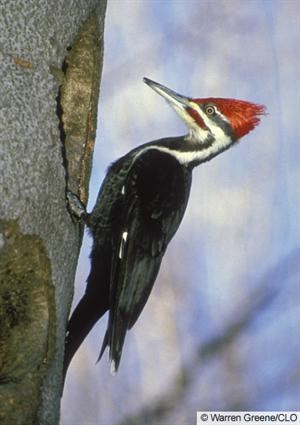
We welcomed the first cool weekend of the fall with a lot of yard work and a surprise visitor. As we sat on the bench in the backyard planning what we wanted to accomplish, a flash of red in the nearby pine trees caught our eye. A loud hammering sound quickly clued us in to the woodpecker nearby, but we were surprised to find it was a Pileated Woodpecker (Dryocopus pileatus), which we've never had the pleasure of seeing around the yard before.


Pileated woodpeckers are the largest woodpeckers in Florida, and get their name from their red cap of feathers. In Latin, pileatus meant "wearing a felt skullcap" (seems sort of an oddly specific word, when you think about it). Incidentally, in case you've ever had trouble pronouncing the word, the preferred pronunciation is "pie-lee-ate-ed", although "pill-ee-ate-ed" is also fine. In both pronunciations, the accent is on the first syllable.


Male and female Pileated woodpeckers can be differentiated by the head. Males have an extra splash of red below the eye (click here to see). Our visitor was lacking that patch, so she was a female. Both forage for food in the same way, by excavating rectangular holes in the bark of trees to find ants and small insects. They make holes so large that other birds come to feed there as well.


Though we've seen Pileated woodpeckers in other places, having one visit My Florida Backyard was very exciting. Somehow, we feel a little more acquainted with a species once it visits us at home. It was a wonderful way to ring in the first weekend of fall weather, and made the hours of weed-pulling ahead seem that much more pleasant.

Thursday, September 29, 2011

Our Only Native Stork

We get many wading bird visitors in My Florida Backyard. A couple of our favorites are Limpkins (which we've written about before) and Wood Storks, both of which are on the endangered list in the United States. It's exciting to know that our lake provides habitat for these birds, which we see regularly enough that if we didn't know they were endangered we would never have guessed.


Wood Storks (Mycteria americana) are the only storks that live and breed in the US. They're found in Florida and along the Gulf Coast, and a few isolated populations are known in North and South Carolina. During the drier months, they're often found in pretty heavy concentrations around freshwater lakes and watering holes, so as the rainy season comes to an end, we'll see larger numbers of them in and around My Florida Backyard.


Wood Storks are easily identifiable by their bald black heads. Presumably this lack of feathers makes feeding easier as there are no feathers to dry and preen after dunking their heads in the water. These birds wade in the shallows and use their brightly colored feet as lures. They trail their open beaks through the water until it makes contact with something (hopefully food), at which point it snaps shut with a reflex response time of 25 milliseconds - an incredibly fast response time among vertebrates.


Wood Storks are also easy to identify in flight. As you can see in the picture above, taken a few years ago, the bottom half of their wings are black. Combined with their dark heads, this makes them easy to tell apart from other large white birds in flight.

We're always very conscious of the amazing array of wildlife in My Florida Backyard. Knowing a species in endangered makes a sighting that much more exciting, but we value every thing that walks or flies through our gardens each day, including these magnificent Wood Storks.

Tuesday, September 20, 2011

The Girl in the Green Jacket

Dragonflies always amaze us with their abilities to come in so many colors and sizes. We love that they hang around eating smaller and more annoying insects like mosquitoes, and that when they mate, they often form a heart-shaped duo. One of the more common dragonflies in Florida is the Common Pondhawk (Erythemis simplicicollis), sometimes called the Green Jacket. The name "Green Jacket" is really only appropriate for females of the species, though - the males are a powdery blue color.

Female Common Pondhawk

Male Common Pondhawk

Dragonflies are amazing in flight, with some species reaching speeds over 40 miles per hour. Their individual wing control allows them to make very precise maneuvers, perfect for plucking a pesky mosquito from mid-air. We always welcome natural mosquito control in My Florida Backyard, and when it comes in such beautifully-colored packaging, we just can't lose!

If you're interested in learning more about dragonflies and their relatives, damselflies, click here to read a post I wrote for Tales From a Butterfly Garden.

Monday, August 29, 2011

Fire and Rain

We've been enjoying the rainy season here in My Florida Backyard. We monitor the rain gauge daily, feeling almost as if we've accomplished something ourselves when there's a good reading, like today's inch and a half. Wandering the gardens after the rains, we love to watch as wildlife re-emerges and activity picks up. This Gulf Fritillary dropped by the Firebush as soon as the last raindrops had fallen.


Firebush (Hamelia patens) is one of our very favorite Florida native shrubs. Though vulnerable to freeze, it grows back so quickly, even from the ground, that it can even be grown up north as a perennial. The "fire" in its name can be attributed to the color of the tube-shaped blooms and leaf stalks, the reddish tinge of the new foliage, or the brilliant flame hue of the leaves in late fall.


Firebush is a terrific wildlife-attractant. Butterflies, especially sulphurs, love it. It's one of the two plants we've seen hummingbirds visit in My Florida Backyard (the other is Coral Honeysuckle). Birds, including Mockingbirds, love to eat the berries that follow the blooms throughout the year.


There is another type of firebush that is not native to Florida: Hamelia patens var. glabra, sold as “Dwarf Firebush”. This non-native hails from Mexico and Central America. There is some concern that it may be hybridizing with our native species, although no particular warnings or prohibitions have yet been issued. Native firebush, shown below and throughout this post, has orange flowers and lighter green leaves, while dwarf firebush has orange and yellow blooms and shiny darker green leaves. Both attract wildlife, but we find native firebush a little easier to grow.


There are still at least six weeks left in the rainy season, and though the temperatures and humidity are high, the rain is welcome in the garden. So for now, the rain continues to fall, wildlife wanders through, and summer lingers on here in My Florida Backyard.

Tuesday, August 23, 2011

Look Alike

Things always seem to slow down in the garden in August. It's so very very hot, with rain nearly every day, and we don't always seem to get out to see what's going on like we do in the cooler months. There's still plenty of activity, though, as we found when we turned over the oleander leaves and discovered some new caterpillars the other day.


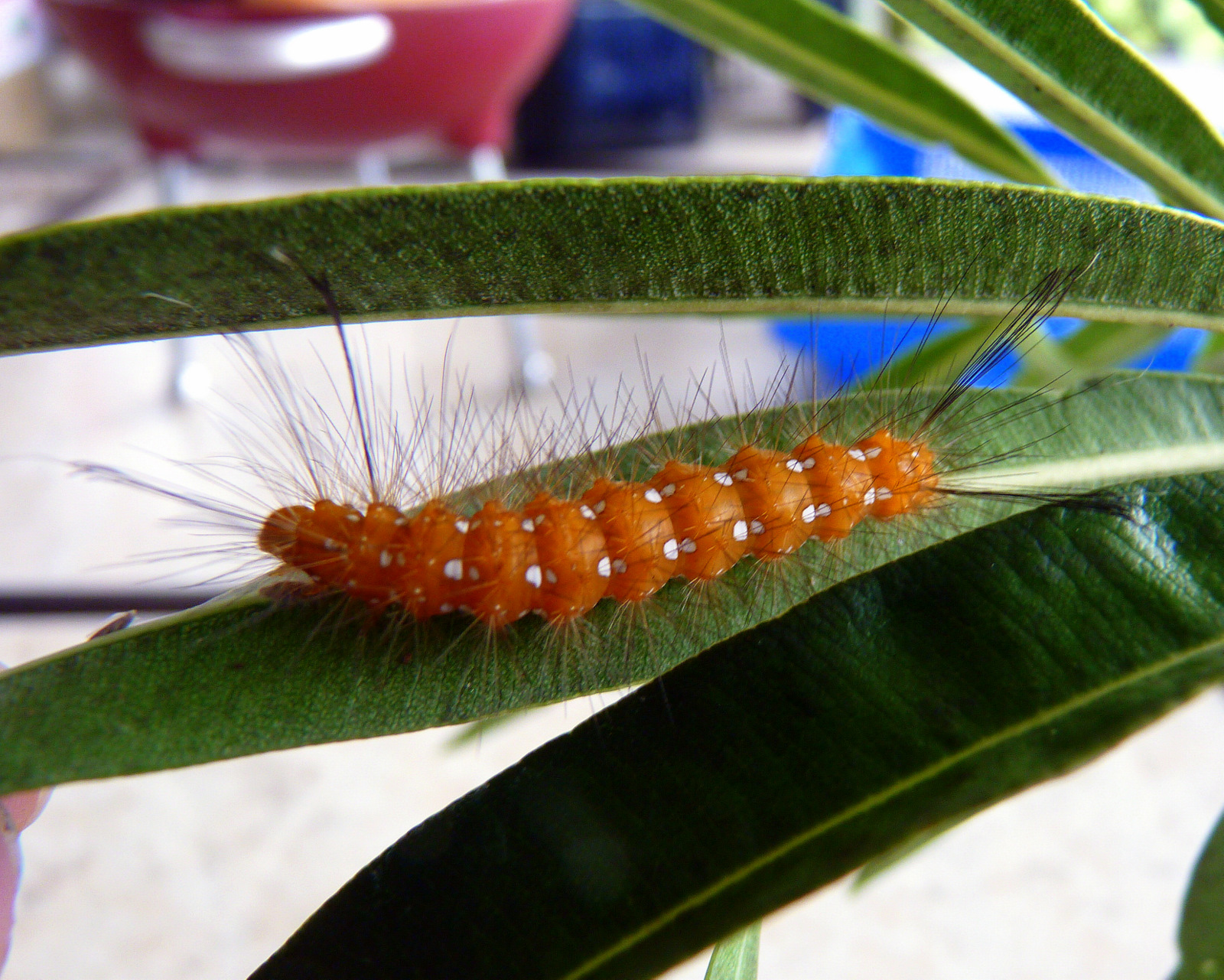
Polka dots! We knew pretty quickly what these caterpillars were likely to be. Last year, we posted about the Spotted Oleander Moth (Empyreuma affinis), a Caribbean species that has been moving its range steadily north for the last 30 years or so. It feeds, as should be extremely obvious, on oleander (Nerium oleander).

The Spotted Oleander Moth is similar in appearance to the Common Oleander Moth, also called the Polka-Dotted Wasp Moth (Syntomeida epilais), both as adult moth and and as a caterpillar. The common oleander caterpillar is familiar to anyone who has oleander in their yards, as a bright orange caterpillar with black spiky hairs (click here to see a picture). The Spotted Oleander Moth caterpillar is also orange, but with white spots and mostly white hairs, with longer black hairs at the front and back.


All parts of the oleander plant are very toxic, so it seems likely that any caterpillars that feed on it would be toxic as well. The bright coloring of the spotted oleander caterpillar is a good indicator of that danger - it's a form of defense called "aposematism". These bright colors basically indicate to possible predators that the organism in question is likely to make them sick if eaten. The hairs of this caterpillar, or setae, are harmless to humans, but likely very irritating to anything trying to ingest it.


The common oleander caterpillar is a known pest on oleander plants, but the spotted oleander caterpillar shown here is not considered to be as destructive as they are not as gregarious. We found only three altogether on our oleander plants, so that seems true. 

Not that it matters to us. Since our yard is designed to attract wildlife, we rarely consider any new creatures to be pests in My Florida Backyard. This recent find was a good reminder that summer heat doesn't keep wildlife from visiting the garden, and it shouldn't keep us from visiting either!

Tuesday, July 19, 2011

Give Me a "J"!

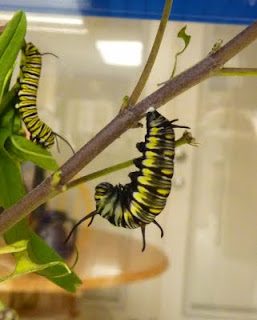
We came around the corner in the garden the other day and almost ran smack into this monarch caterpillar, hanging in the classic "J" position and preparing to pupate into chrysalis.


This is a pretty common sight in My Florida Backyard. Most species of butterfly caterpillars display this behavior, spinning a silk pad and attaching their hind end to it by a hook called a "cremaster". The rest of their body hangs free, allowing the caterpillar to shed its skin one last time and form a chrysalis. (Learn more about each species below by clicking the name.)


Other butterfly species hang in a modified "J", using a second strand of silk to secure themselves across the middle. This adds an extra level of security in case the cremaster accidentally becomes detached.


Observing the full life cycle of butterflies is just one of the joys of building and maintaining a wildlife habitat. Watching these creatures from egg to caterpillar to pupa to butterfly never fails to impress us with the amazing complexity of nature at its finest!

Thursday, July 14, 2011

Over My Shoulder

We were a little startled this evening by the bird perched on our backyard feeder. He was most definitely not there for the safflower seed...  that's just not part of the diet of a juvenile Red-Shouldered Hawk (Buteo lineatus).


We made our way outside to see him a bit more clearly. We knew he was juvenile because of the white coloration of his breast. Adults have reddish-brown breast feathers. The tail feathers also show distinct bands, a characteristic of a younger hawk of this species.


Red-shouldered hawks are a common predator in My Florida Backyard. They've been responsible for picking off plenty of baby ducklings, and last year we watched one take down a crow (click here to learn more). If this one continues to haunt the bird feeder, we will most likely see very few songbirds for awhile, but tonight the sight of this hawk was enough to fill us with awe... and that's enough for one day.

Saturday, June 11, 2011

Daily Growing

The mockingbabies are about 5 days old now, and while we wouldn't say they're all that much cuter, they're definitely bigger! As of this morning, their eyes are open and they have begun making faint "cheeping" noises in response to sounds. They are also beginning to develop pin feathers on their wings. Still, they're mostly beak and fuzz, and they spend their days eating and sleeping... just like most babies. Here's a picture of the mockingparents - they take turns on food duty and watch duty pretty much all day long.


Here are the latest baby photos, and a short video in which you can hear some of their "first words". Enjoy, and check back early next week for another mockingbaby update!


Tuesday, June 7, 2011

Hush Little Baby

A few weeks ago, we noticed an exciting event taking place in My Florida Backyard. For the first time since we've lived here, a pair of birds have decided to nest on our property! They're Northern Mockingbirds, and they've built their nest in the honeysuckle right off the back porch, giving us a front row view to all the action. We've been documenting the action over the last couple of weeks, and this morning, we found the hatchlings have emerged! Here's the lead-up to today's blessed event:


And here are the three unbelievably ugly babies! They are obviously very newly-hatched, possibly just today. Their eyes are not yet open, and they aren't chirping yet. While their parents are out foraging for food, the chicks just lay limply in the nest awaiting the next meal, at which point their little heads shoot up and their beaks open wide...


And finally, let's go to the videotape! We made some chirping sounds like their parents might to see their response... do you think these little guys are hungry?


We'll be documenting their growth in the days ahead. Check back often for updates on the mockingbabies!