Tuesday, September 27, 2011

From Orange to Pink

The amazing Florida photographer and artist Clyde Butcher has said that in Florida, clouds are our mountains. The towering banks of afternoon thunderheads add the texture to the sky that our flat landscape lacks. In fact, our flat landscape provides the wide-open sky needed for spectacular displays, whether it's the powerful spectacle of lightning in the distance, or the vivid but silent splash of color across the evening sky at sunset.


Come watch with me the shaft of fire that glows
In yonder West; the fair, frail palaces,
The fading alps and archipelagoes,
And great cloud-continents of sunset-seas.
~Thomas Bailey Aldrich, "Miracles"

Saturday, September 24, 2011

Orange in Bloom

This spring, we planted a variety of new canna bulbs we ordered online. Cannas come in a wide selection of colors, most of which aren't available locally, but you can find some interesting options online. Since we planted them, they've grown well, putting on plenty of large green leaves, but have been very slow to bloom. This past week, at last, one of the new plants finally deigned to show some color.


This isn't one of the showier cannas we planted. It's called Tangelo, and on closer inspection, you can see the orange blooms are actually touched with yellow.


Fortunately, the occasional invasion from canna skipper caterpillars don't really damage the blooms, though they do cause some leaf damage. As wildlife gardeners, we tolerate these caterpillars rather than use pesticides, although if we spot the eggs before they hatch, we scrape them off. They're fascinating caterpillars, as we've noted before in previous posts.


We're still waiting on some of the more exotic-colored flowers to make their first appearances, like Cleopatra and Yellow King Humbert. We planted them in an area with part shade, which is usually fine for Cannas this far south, but we're wondering if this could be keeping them from flowering. Fortunately, since they're bulbs, they'll be easy to transplant this winter or spring if we need to.


In the meantime, we'll appreciate the blooms we have. Autumn is here, according to the calendar, so hopefully soon the temperatures will drop and we'll be outside doing clean-up and new fall plantings. We can hardly wait!

Tuesday, September 20, 2011

The Girl in the Green Jacket

Dragonflies always amaze us with their abilities to come in so many colors and sizes. We love that they hang around eating smaller and more annoying insects like mosquitoes, and that when they mate, they often form a heart-shaped duo. One of the more common dragonflies in Florida is the Common Pondhawk (Erythemis simplicicollis), sometimes called the Green Jacket. The name "Green Jacket" is really only appropriate for females of the species, though - the males are a powdery blue color.

Female Common Pondhawk

Male Common Pondhawk

Dragonflies are amazing in flight, with some species reaching speeds over 40 miles per hour. Their individual wing control allows them to make very precise maneuvers, perfect for plucking a pesky mosquito from mid-air. We always welcome natural mosquito control in My Florida Backyard, and when it comes in such beautifully-colored packaging, we just can't lose!

If you're interested in learning more about dragonflies and their relatives, damselflies, click here to read a post I wrote for Tales From a Butterfly Garden.

Wednesday, September 14, 2011

Laying Low

This mallard is taking it easy in the summer heat...
and so are we.
You may have noticed the scarcity of posts here on My Florida Backyard in recent weeks. We're still here - we promise. It just seems hard to find much to write about lately. The yard is overgrown and new plantings are still a few weeks off, waiting for the day when the forecast stops including 90-degree temperatures. Birds, except for ducks, have mostly deserted us, since food is plentiful everywhere and they don't need to flock to backyard feeders or inland ponds like they do in mid-winter. Caterpillars still abound, but you can only write so many posts about them, no matter how much you love them.

We're still dedicated to our yard and to wildlife, though. I'm doing a lot of writing for other blogs, where the posts don't depend so heavily on the wildlife in and around our little suburban lot. I've been writing about stinging caterpillars and swarming hummingbirds over at the Birds & Blooms Blog, among other things of interest to Southeastern gardeners and birders. I've also done some posts on how caterpillars use silk and edible caterpillars for Tales From the Butterfly Garden, a blog that takes you behind the scenes of the MOSI BioWorks Butterfly Garden where I work. Drop by and check out these posts and others, if you like.

My Florida Backyard should be full of excitement again before too long. Migration season is in full swing, so we're about to fill the bird feeders and see who drops by. Fall color is just around the corner too, with purple asters, blooming muhly grass, and ripe beautyberries all waiting to be admired. So don't take us off your "to read" list... we promise to be back just as soon as there's something fun and interesting to report!

Monday, September 5, 2011

Hidden Away

We know we've been a little remiss with the blog posts here on My Florida Backyard lately. It seems we're in the doldrums of late summer, with not much happening. We've started clearing out some of the overgrowth lately, though, getting ready for some fresh fall plantings whenever that cooler fall weather arrives. Recent rains and winds had beaten our amazing forest of Partridge Pea down, so we removed nearly all of it, leaving just a few plants to provide seed for next year. The butterfly garden is very bare without it.


On the plus side it gave us a chance to rediscover some of the plants tucked away underneath it all. The dotted horsemint (Monarda punctata) is even more prolific than we had realized.


Some 'Coral Nymph' Salvia coccinea is doing pretty well under there as well, along with some purple Lantana montevidensis.


Nearby, after pulling some overgrown grass and other weeds, we found some brilliant pink Pentas lanceolata, along with an orange zinnia that must have popped up from seed.


So, we found some hidden treasure in the garden, which was nice. Oh, and don't worry about the sulphur butterflies who were using the Partridge Pea as host plants - they've got plenty of room on the nearby Cassia bicapsularis for their caterpillars!

Monday, August 29, 2011

Fire and Rain

We've been enjoying the rainy season here in My Florida Backyard. We monitor the rain gauge daily, feeling almost as if we've accomplished something ourselves when there's a good reading, like today's inch and a half. Wandering the gardens after the rains, we love to watch as wildlife re-emerges and activity picks up. This Gulf Fritillary dropped by the Firebush as soon as the last raindrops had fallen.


Firebush (Hamelia patens) is one of our very favorite Florida native shrubs. Though vulnerable to freeze, it grows back so quickly, even from the ground, that it can even be grown up north as a perennial. The "fire" in its name can be attributed to the color of the tube-shaped blooms and leaf stalks, the reddish tinge of the new foliage, or the brilliant flame hue of the leaves in late fall.


Firebush is a terrific wildlife-attractant. Butterflies, especially sulphurs, love it. It's one of the two plants we've seen hummingbirds visit in My Florida Backyard (the other is Coral Honeysuckle). Birds, including Mockingbirds, love to eat the berries that follow the blooms throughout the year.


There is another type of firebush that is not native to Florida: Hamelia patens var. glabra, sold as “Dwarf Firebush”. This non-native hails from Mexico and Central America. There is some concern that it may be hybridizing with our native species, although no particular warnings or prohibitions have yet been issued. Native firebush, shown below and throughout this post, has orange flowers and lighter green leaves, while dwarf firebush has orange and yellow blooms and shiny darker green leaves. Both attract wildlife, but we find native firebush a little easier to grow.


There are still at least six weeks left in the rainy season, and though the temperatures and humidity are high, the rain is welcome in the garden. So for now, the rain continues to fall, wildlife wanders through, and summer lingers on here in My Florida Backyard.

Tuesday, August 23, 2011

Look Alike

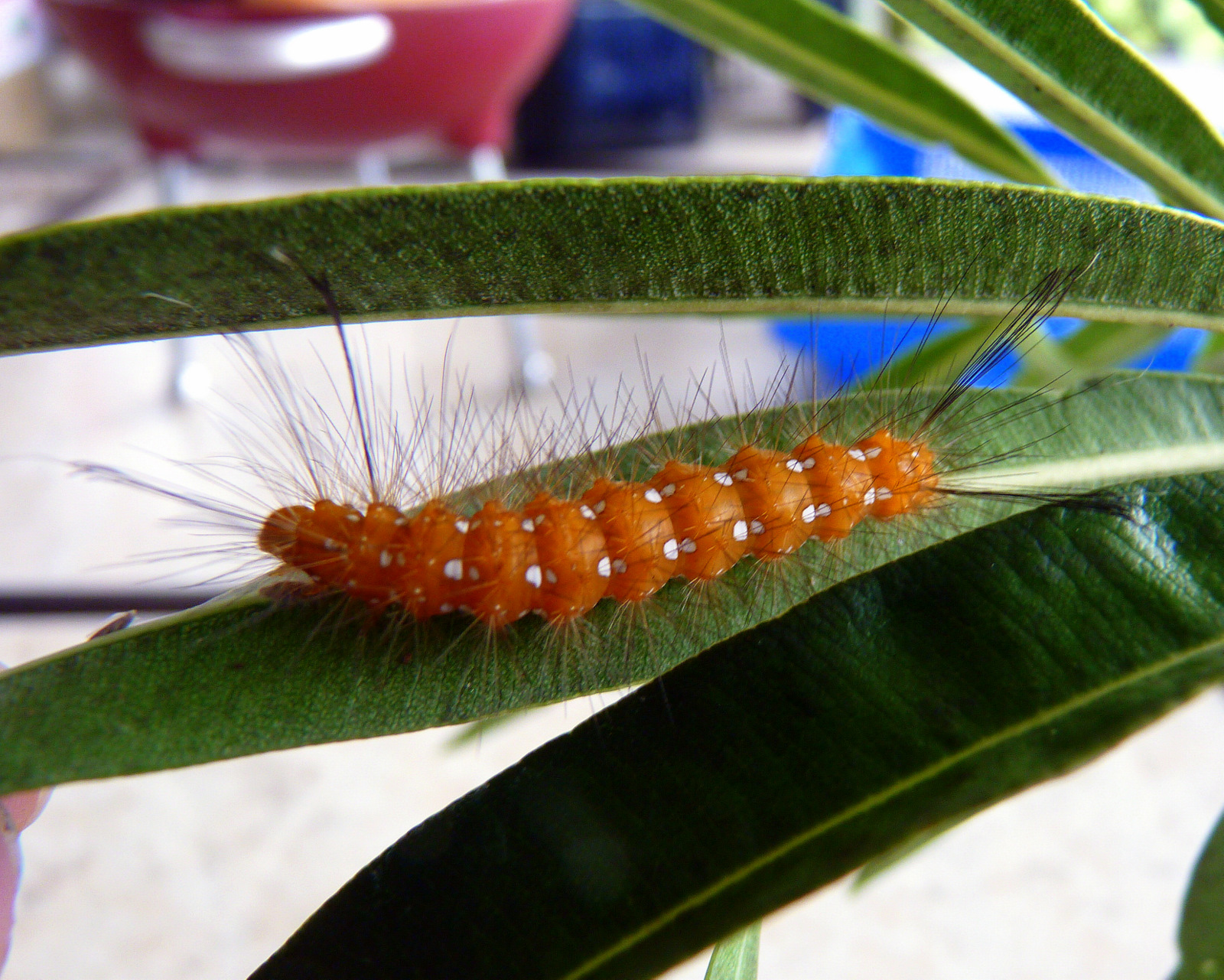
Things always seem to slow down in the garden in August. It's so very very hot, with rain nearly every day, and we don't always seem to get out to see what's going on like we do in the cooler months. There's still plenty of activity, though, as we found when we turned over the oleander leaves and discovered some new caterpillars the other day.


Polka dots! We knew pretty quickly what these caterpillars were likely to be. Last year, we posted about the Spotted Oleander Moth (Empyreuma affinis), a Caribbean species that has been moving its range steadily north for the last 30 years or so. It feeds, as should be extremely obvious, on oleander (Nerium oleander).

The Spotted Oleander Moth is similar in appearance to the Common Oleander Moth, also called the Polka-Dotted Wasp Moth (Syntomeida epilais), both as adult moth and and as a caterpillar. The common oleander caterpillar is familiar to anyone who has oleander in their yards, as a bright orange caterpillar with black spiky hairs (click here to see a picture). The Spotted Oleander Moth caterpillar is also orange, but with white spots and mostly white hairs, with longer black hairs at the front and back.


All parts of the oleander plant are very toxic, so it seems likely that any caterpillars that feed on it would be toxic as well. The bright coloring of the spotted oleander caterpillar is a good indicator of that danger - it's a form of defense called "aposematism". These bright colors basically indicate to possible predators that the organism in question is likely to make them sick if eaten. The hairs of this caterpillar, or setae, are harmless to humans, but likely very irritating to anything trying to ingest it.


The common oleander caterpillar is a known pest on oleander plants, but the spotted oleander caterpillar shown here is not considered to be as destructive as they are not as gregarious. We found only three altogether on our oleander plants, so that seems true. 

Not that it matters to us. Since our yard is designed to attract wildlife, we rarely consider any new creatures to be pests in My Florida Backyard. This recent find was a good reminder that summer heat doesn't keep wildlife from visiting the garden, and it shouldn't keep us from visiting either!