Showing posts with label insects. Show all posts

Sunday, June 17, 2012

Differences

After discovering our first Zebra Longwing caterpillars ever in My Florida Backyard a few weeks ago, we're now noticing clutches of eggs on the passionvine too. Passionvine (Passiflora spp.) is a popular host plant. In Central Florida, it's used by Gulf Fritillaries and Zebra Longwings. Further south, it's used by Julia Longwings, and to the north by Variegated Fritillaries. (Learn more about all these butterflies and caterpillars here.)

The eggs of Zebra Longwings and Gulf Fritillaries look very similar, but due to the laying habits of the butterflies, you can actually tell them apart pretty easily. Zebra Longwings lay eggs in clusters at the ends of vines, while Gulf Fritillaries lay their eggs singly, often on the upper sides of leaves. (The pictures below aren't of the greatest quality, but they help explain the point.)

Zebra Longwing Eggs

Gulf Fritillary Egg

Once hatched, the caterpillars have similar feeding habits. It takes them about two weeks to grow full-size and pupate to chrysalis. They then spend about two weeks hanging in chrysalis before emerging as butterflies. Gulf Fritillaries round out the life cycle by spending about two weeks feeding and mating before they die, but Zebra Longwings are actually much longer lived as adults. They are one of the few butterflies that possess the ability to digest pollen in addition to nectar, allowing them to expand their lives as butterflies to as much as six months or more. The pollen collects on their proboscis and is digested externally (click here to see a picture of a Zebra Longwing with collected pollen) - a cool and unusual process in the insect world.

We love nature of all sizes in My Florida Backyard, but we're especially fond of it on a small scale. It's endlessly fascinating to flip a leaf and see what's beneath!

Friday, May 18, 2012

Empty Shell

While filling the bird feeder today, we found an empty insect exoskeleton clinging to the bottom. (It almost seems to have a golden glow here, but that's just the effect of the camera flash.)


Our first instinct, from past experience, was that it must be a cicada shell. But something didn't seem quite right; the legs were too long, the body not chubby enough.


A few internet searches later, we felt reasonably certain in stating this this was instead the exuvia, or final shed exoskeleton, of a dragonfly, although we can't be certain of the species. It's not uncommon for a dragonfly nymph to crawl some distance away from the water to undergo its final transformation. We detached it carefully to take a closer look.


Here's a closeup of the incredibly detailed head, with staring eye capsules front and center and the tiny antenna clearly delineated:


When we flipped the shell over, the mandible was obviously visible too:


The wings seem too small and the body section too large, until you remember that when the dragonfly emerges, it pumps fluid (haemolymph) from its body into its wings to expand and inflate them. (See great photography of this process here.)


The incredible detail left behind on the exuvia shows what an intricate creature the resulting dragonfly truly is. We've admired them as adults many times, and we love knowing that My Florida Backyard plays a role in their life cycle beyond just providing yummy mosquitoes for their dinners!

Tuesday, September 20, 2011

The Girl in the Green Jacket

Dragonflies always amaze us with their abilities to come in so many colors and sizes. We love that they hang around eating smaller and more annoying insects like mosquitoes, and that when they mate, they often form a heart-shaped duo. One of the more common dragonflies in Florida is the Common Pondhawk (Erythemis simplicicollis), sometimes called the Green Jacket. The name "Green Jacket" is really only appropriate for females of the species, though - the males are a powdery blue color.

Female Common Pondhawk

Male Common Pondhawk

Dragonflies are amazing in flight, with some species reaching speeds over 40 miles per hour. Their individual wing control allows them to make very precise maneuvers, perfect for plucking a pesky mosquito from mid-air. We always welcome natural mosquito control in My Florida Backyard, and when it comes in such beautifully-colored packaging, we just can't lose!

If you're interested in learning more about dragonflies and their relatives, damselflies, click here to read a post I wrote for Tales From a Butterfly Garden.

Sunday, February 6, 2011

Solitary Man

On a routine trip around the yard to see what's been going on, we stumbled across this monarch butterfly clinging to some passionvine. His fairly sluggish movements and nearly perfect wings led us to believe he was probably newly emerged from chrysalis, hanging out for awhile before going off to find a first meal.


Butterflies are not nearly as common in My Florida Backyard during the winter months, but when we do come across them, they're always a welcome sight. In fact, photographing butterflies can be a lot easier in the winter, because the cooler temperatures mean you can often find them just basking in the sunlight, building up the energy to fly. This offers great opportunities to get up close; all of these shots were taken without a zoom lens. On a cloudy, cooler day, butterflies just don't have the get-up-and-go to get up and go.


When this monarch dropped to the ground and opened his wings, we could see he was a male by the black scent gland spots on his lower hindwings. In their fairly short life span (usually just weeks), butterflies have just two purposes: to eat and to mate. Unlike in summertime, when the gardens are full of prospective mates, this monarch may have to work a little harder to find some lady friends. They're out there though - we saw a female feeding from the milkweed just a few days ago.


Photographing butterflies can be a challenge, but winter days offer a chance to polish your skills. You don't need a super fancy camera to get decent shots, if you're patient. (Ours is only a high-end point and shoot model.) If your camera has a macro setting, be sure to use it. A setting that allows you to take multiple shots with one button click is good too. Get as close as possible before using your zoom lens for the best quality. And don't be afraid to use a photo editing program like Picasa to crop your pictures and do some minor editing to show the butterflies to best advantage.


Have you had any butterfly sightings in your own yards? With the arrival of spring, watch for buckeyes, red admirals, and whites to appear - we've already seen a few. Soon, this solitary monarch will have more company in the butterfly garden. In the meantime, he's a welcome bright splash of color on an otherwise quiet gray day in My Florida Backyard.

Thursday, December 23, 2010

Everything's Coming Up Roses

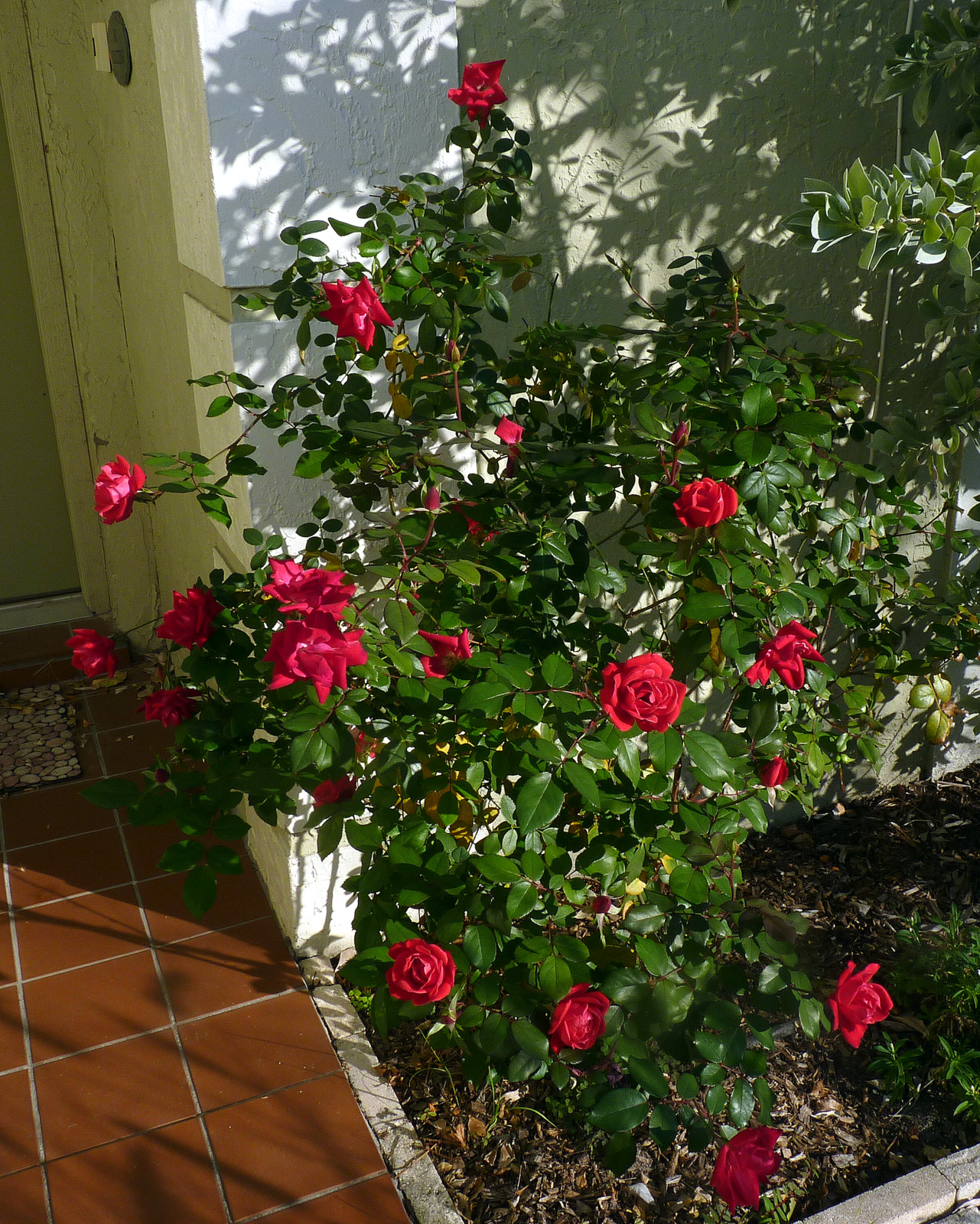
Wow, the Knockout Rose by our front door is happy! Although Knockouts can withstand the heat of a Florida summer, they're much happier when the cooler weather sets in. We gave ours a shot of fertilizer a few weeks ago and covered it during the freeze last week to protect the buds, and it's really paying off!


Oh, and the bees are enjoying it too...


Roses in winter... just one more reason we here in My Florida Backyard couldn't imagine living anywhere else!

Wednesday, November 3, 2010

You Hit the Spot

Recently, My Florida Backyard has been visited by a moth that seems to be a little out of its range: a Spotted Oleander Moth (Empyreuma affinis). Like all Lepidoptera, they don't really like to hold still for pictures, but we managed to snap a few to help us with identification.


The Spotted Oleander Moth is part of a group known commonly as Wasp Moths (taxonomic subtribe Euchromiina). Although they resemble wasps in shape, they do not sting or bite - though most predators probably don't realize that. They are diurnal, meaning they fly during the day, unlike many other moths which are nocturnal.


The Spotted Oleander Moth is native to the Caribbean region. It's only been found in Florida for the last 30 years or so, and is seen primarily in the Keys and South Florida. We could find only one other reported sighting in Central Florida, and it was as recent as last month. Perhaps this species is starting to populate further north?


As its name suggests, the caterpillar of this species feeds on Oleander (Nerium oleander), a non-native flowering shrub frequently used in landscaping across the state. We don't grow any oleander in My Florida Backyard, but there's plenty of it in the neighborhood, and the relatively frequent sightings of this insect lately lead us to believe there is a breeding population locally.


A similar and more prevalent species in Central Florida is the Common Oleander Moth, also known as the Polka-Dot Wasp Moth (Syntomeida epilais), whose caterpillar is often considered a pest on oleander due to its habit of defoliating the plant very quickly and efficiently. The Spotted Oleander Moth is considered less destructive, probably because it is less common.


If you've noticed the Spotted Oleander Moth in your Central Florida yard, let us know in the comments. We're interested in finding out how prevalent this species is becoming in the area.

Tuesday, October 12, 2010

Paper Chase

Seeing one creature attack and devour another is never easy, no matter the size. Whether it's an egret gobbling up a lizard, or a  hawk snatching duckling from under its mother's beak, the circle of life is disturbing... and fascinating.

Today's featured predator is the paper wasp. Wasps are a beneficial insect in the garden, keeping other insects in control, especially flies and caterpillars. This is all well and good, unless of course you happen to like caterpillars, in which case it can be a little demoralizing to watch wasps picking them off one by one.

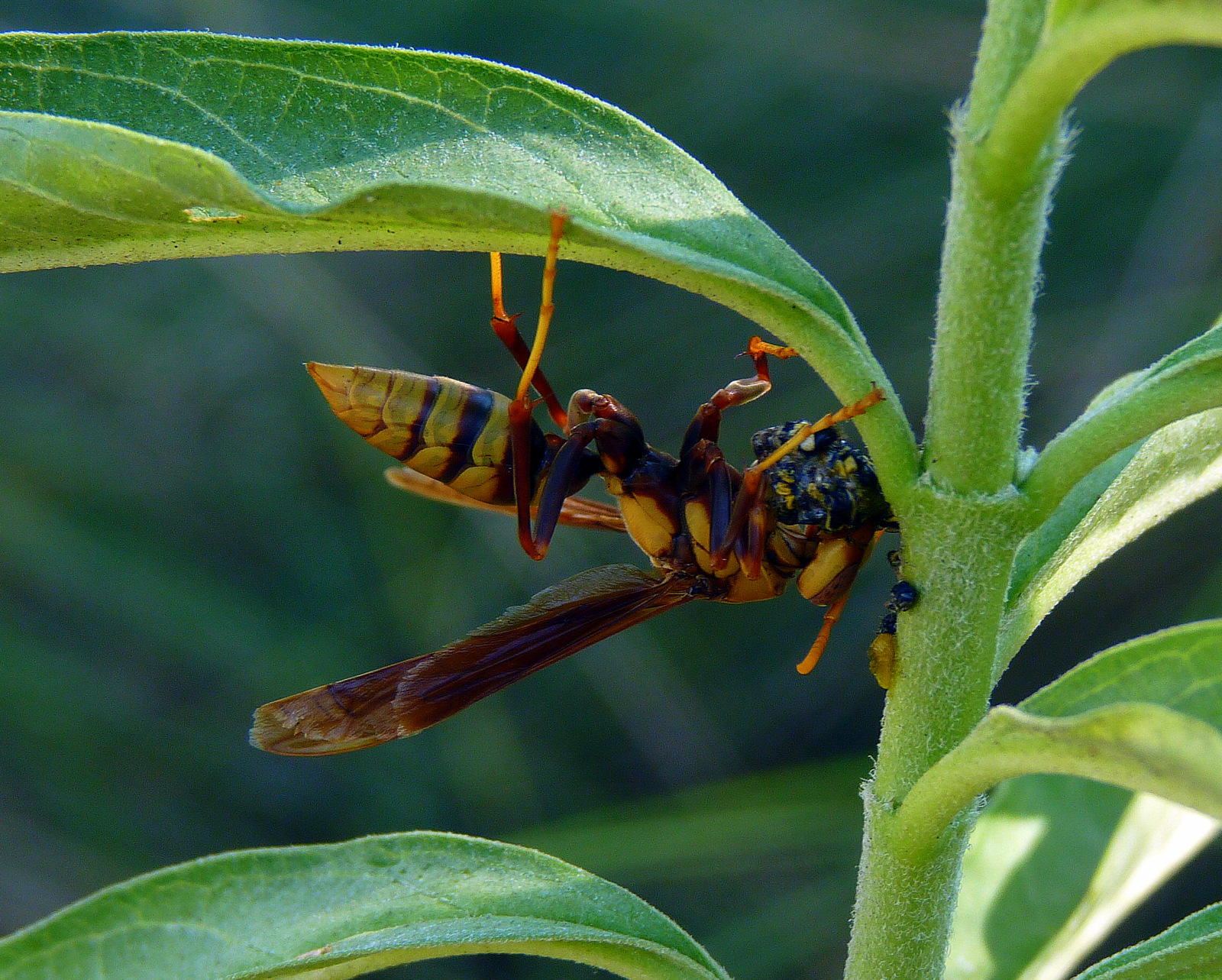
The paper wasp below was finishing up a monarch caterpillar feast when we found him. He'd made a bit of a mess, and was surrounded by partially digested milkweed from the caterpillar's gut.


You can easily see that this was once a monarch caterpillar - the yellow and black stripes are still present, along with the long black tubercules from its head.


Though this seems to be a gruesome sight, there's a softer side to the story. Adult wasps get their own sustenance from nectar. When they feed on caterpillars, what they're really doing is storing up food to take back to the nest, where they'll regurgitate the partially-digested caterpillar to feed the wasp larvae.


So, the wasps won this battle. However, on milkweed nearby, we spotted at least 5 other nearly full-grown monarch caterpillars, and dozens of eggs. The wasps are just filling their part in the circle, keeping caterpillar and butterfly populations in check. Nature is a delicate balance, and My Florida Backyard is glad to be part of the scales.

Note: While wasps can be aggressive, this one was too busy chowing down to be concerned with our camera. Still, you should always take precautions around wasps of any kind; you never know when they might turn on you.

Thursday, September 23, 2010

Blue Tail Fly

My Florida Backyard teems with the circle of life, and though we love to observe creatures as they go about their daily business, there can be benefits to finding one whose time is done. It provides the ability to safely observe them up close, admiring details you might not see when they're in motion.

The other day, we found this massive dragonfly dangling from an old spiderweb and took the opportunity to get some great pictures.


Dragonflies are one of nature's "beneficial insects", as they dine on pesky mosquitoes and other little bugs. They seem to come in endless colors (hot pink is our favorite) and sizes, and this was one of the biggest we'd ever seen, part of the group we like to call "747 dragonflies". We felt privileged to have a chance to examine it up close.

Monday, July 26, 2010

If You Want To Know Who We Are

On an average day, we spot anywhere from five to ten different butterfly species in My Florida Backyard, and that's usually just as we're passing through or looking out the back window. There's always a gulf fritillary or six hanging around, monarchs laying on the milkweed, sulphurs attracted by the cassias, and tiny skippers galore. Some butterflies are easy to identify - nearly anyone can tell you what a monarch looks like - but others take a little more work, especially if you only see them flitting through the air rather than at rest.

One of our biggest challenges has been telling apart Eastern Black and Spicebush Swallowtails. Their shape, size, and markings are very similar. In fact, both are mimics of the foul-tasting female pipevine swallowtail, adding another butterfly species into the mix to confuse those trying to identify them. However, if you happen to see these butterflies at rest with their wings open, there is a pretty simple trick you can use to help you out. Kristen G, who runs the butterfly garden and historic tree grove at MOSI, explains:
"The best way to be sure is to follow the inside line of the hind wing to the bottom, near the tails. Spicebush Swallowtails may have a blush of orange marking but [Eastern] Black Swallowtails have an orange or yellow marking with a black eye-spot in the center."
So, let's compare. In first picture below, which we took last year and correctly identified as an Eastern Black Swallowtail, we can clearly see the eyespot Kristen describes.


In this next picture, taken this past weekend, the eyespot is absent. This picture shows a male Spicebush pursuing a female. The female's markings, shown clearly in the first picture of this post, are even more similar to the Eastern Black's.


Life would be easier here in My Florida Backyard if we didn't have inquiring minds that always want to know "What exactly is that?". We could just sit back and enjoy the spectacle, and we often do. But we're happiest when we know exactly what we're looking at, because then we can learn more about it, including how to make sure it visits My Florida Backyard again and again!

Tuesday, July 20, 2010

Yellow Days

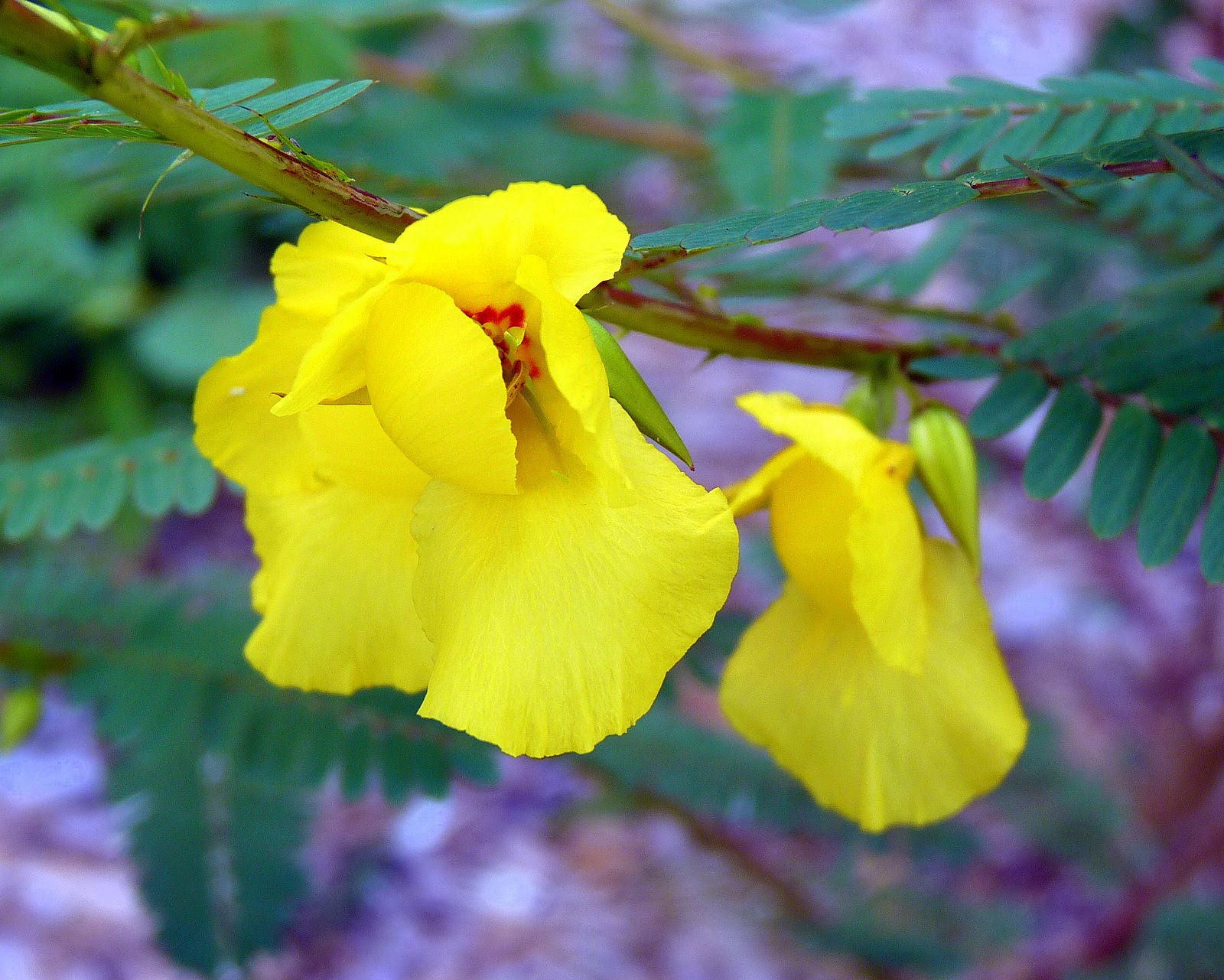
The hot and hazy days of summer are here, and yellow seems to be the prevailing color in My Florida Backyard. Lantana, zinnias, yellowtop, rosinweed - all are spreading cheery yellow blooms beneath the steamy summer sun. In the last few days, the Partridge Pea began to bloom, adding to the golden glow of the garden.


Partridge Pea (Chamaecrista fasciculata) is a native wildflower in Florida and throughout much of the U.S. east of the Rockies. It's an annual, lasting until the first heavy frost, but reseeds easily. Once you have it established in an area, you can expect to see it pop up each summer without any encouragement. It grows quickly from the ground; the plant shown above took about a 4-6 weeks to reach its current height of about 3 feet. The leaves are feathery and sensitive to the touch; the leaflets will fold up during rain and each evening at dusk. The bright yellow flowers appear along the stem at intervals where the leaves meet the stem (known as the "leaf axil"), and will be followed by seed pods that resemble pea pods.

Partridge Pea serves as a host plant for several butterflies, including the Sleepy Orange and some sulphurs. My Florida Backyard has been invaded regularly by Sleepy Oranges lately, and the Partridge Peas are full of eggs, which resemble little grains of rice. Because Partridge Pea has nectar glands along the stem, the plant is very attractive to ants. These ants will frequently carry off the caterpillar eggs and even young caterpillars, so it's a good thing that the butterflies lay their eggs in volume. A recent survey of one Partridge Pea plant yielded over 30 eggs before the surveyor (yours truly) stopped counting due to the sweat blurring her vision.

We love any plant that brings butterflies to My Florida Backyard, and Partridge Pea is an easy-to-grow native that fits in any wildflower garden. Obtaining seeds or starter plants can be a little difficult; try a native nursery or wildflower website, or watch for plants along the side of the road and gather some seeds for yourself (not on private property, of course!). If you can get your hands on it, Partridge Pea is definitely worth the space in your wildlife-friendly garden!

Tuesday, July 6, 2010

I've Got My Eyes on You

Just when we think we've seen it all here in My Florida Backyard, along comes something that makes us step back and say, "What the HECK is that???"


It's important to understand, mind you, that this beetle was nearly TWO INCHES long - almost the length of my pinky finger. At first sight from the other side of the screen, I wondered if it was an especially big specimen of what we Floridians delicately call a Palmetto bug (and the rest of the world knowingly calls a disgusting cockroach) - we've seen some pretty darn large ones, I'm sorry to say. But when I came around to the other side of the screen and saw the distinctive markings, I knew I was definitely looking at something else.


A quick search of BugGuide.net showed this to be an Eyed Click Beetle (Alaus oculatus), a pretty common beetle in the eastern US. It's known to eat some nectar, so perhaps it's not surprising we found it near the butterfly garden, which is full of nectar plants. It takes its name from the large eye spots on the pronotum, which are most likely used to fool predators much like the Buckeye butterfly does. You can learn more about this beetle and see some really incredible pictures by clicking here.

You never know what's going to cross your path in My Florida Backyard... and that's the way we like it.

Thursday, May 6, 2010

Stop! In the Name of Love!

Although it seems to be a little late this year, the Simpson's Stopper (Myrcianthies fragrans) is finally in bloom! We have three of these native shrubs in My Florida Backyard, and over several years these have proven to be one of our favorites. They are hardy to about 25 degrees, so they made it through the hard winter with only superficial damage to outer leaves. This is a nice shrub for areas ranging from mostly sun to full shade, and we have two that grow well on the north side of the house, where they receive only small amounts of sun. In the fall, they provide nice deep orange berries the birds seem to appreciate.


Apparently we're not the only ones who think the showy little blooms are great - today I found that one of our stoppers was covered in love bugs doing the things that love bugs do (namely, eating and mating).


Floridians are plenty familiar with lovebugs (Plecia nearctica), and depending on where you live, you may even dread the season for the damage it does to your car's front grill. They're interesting little creatures though - very single-minded and successful. They spend their larval stage in grassy areas eating dead vegetation, helping to keep the thatch under control. In May and September, they hatch en masse and immediately get to work.

Adults eat the nectar of blooming plants, and obviously the Simpson's Stopper was quite the draw this year - kind of like a singles bar for bugs. These bugs don't waste time, as their life spans are only a few days. In fact, they find mates almost immediately upon hatching, and stay connected until their deaths. The female will even drag the dead (and still attached) male around until she's ready to lay her eggs. This romantic(?) activity has given them their common name - lovebugs.

Whether you love them or hate them, they are certainly a quintessential Florida sight this time of year!