Showing posts with label invasive species. Show all posts

Friday, February 3, 2012

Two Little Flowers

The spring rehabilitation of My Florida Backyard has begun at last! We started small, with our favorite cool season wildflower - it's Tampa Vervain time! Each year, we wait eagerly for Tampa Mock Vervain (Glandularia tampensis) to start showing up at nurseries. Butterflies love it, and it flowers non-stop from now until the hot and humid summer days set in.


We mixed it with another tiny flower that butterflies adore, gold lantana (Lantana camara 'New Gold'). We like this lantana because even though some varieties of L. camara are found on the invasive lists, 'New Gold' is considered sterile and doesn't spread beyond where you plant it.


Purple and yellow is one of our favorite color combinations - together the two just look so happy and spring-like. And this will make a nice little corner for butterflies to visit while we work on the rest of the yard and gardens.


There's plenty more planting ahead this weekend in My Florida Backyard, so drop by in a few days to see the changes!

Tuesday, April 26, 2011

Flying Dutchman

When Calico Dutchman's Pipevine (Aristolochia littoralis) flowers, you really can't miss it. The blooms are the size of dinner plates, and up close the smell is fairly unpleasant. Still, the blooms are fascinating in color and shape.


Honestly, we probably shouldn't have this vine in our yard. A. littoralis is invasive in Florida (it's currently on the FLEPPC Category II list). We keep it around for the Polydamas Swallowtail caterpillars to feed on. However, because it's from South America, it's actually toxic to the Pipevine Swallowtail caterpillars who also can accidentally lay on it.

Fortunately, it's easy to tell the eggs of the two species apart, so by watching the vines carefully for eggs, we can remove the red ones of the Pipevine ST to the native A. tomentosa that we also grow. (Polydamas eggs are yellow.) If you're not willing to take the time to do this, it's probably best for butterfly gardeners to eliminate A. littoralis from the yard to avoid harming our native butterflies.

Thursday, February 3, 2011

Ring Out, Wild Bells

"Ring out, wild bells, to the wild sky,
The flying cloud, the frosty light..."

Tennyson began his famous poem this way, and perhaps it seems odd that these lines turn my thoughts to Coral Honeysuckle (Lonicera sempervirens). But bear with me a moment - this Florida native wildflower is one that thrives in the cooler winter weather, and from the living room window, we often see the vibrant bells outlined against a grey sky on a cool evening, or whipping in the wind on wild afternoon. Though it does well all year in Florida, Coral Honeysuckle seems to love the unpredictable ups and downs of winter.


Honeysuckles are well-known and well-loved the world over. Most people associate them with fragrant summer nights or lazy afternoons, their sweet smell accompanied by the buzzing of bees and flutter of hummingbird wings. These dreamy visions are generally inspired by the honeysuckles of Europe (Lonicera periclymenum) or Asia (Lonicera japonica), though, as L. sempervirens doesn't have much of a fragrance. This hardy evergreen bloomer seems wilder and simpler than its foreign cousins, more suited to life in the New World.


Unlike the invasive Japanese Honeysuckle, Coral Honeysuckle is friendly to Florida gardeners. It's happy to climb up a fence or clamber over a trellis, but it doesn't wander and it's easy to control. It doesn't climb using tendrils or suckers, so it won't drown out other plants and shrubs nearby. We grow ours to hide some downspouts in the butterfly garden. It does well in full or partial sun, and handles droughts, heat waves, frosts, and pretty much all other weather without blinking an eye.


Don't let its lack of obvious fragrance fool you - Coral Honeysuckle is a natural in the butterfly garden. The few hummingbirds we've spotted in My Florida Backyard have been seen feeding from this plant or a nearby firebush (Hamelia patens). The foliage is said to be a host plant for Leopard Moth caterpillars, among others. The blooms themselves are simple but lovely... brilliant red outside with a surprising splash of yellow on the inside.


Coral Honeysuckle is readily available at native plant nurseries. Avoid the non-native honeysuckles you see for sale at big-box stores and instead seek out this wonderful native, which seems to have the "sweeter manners" of which Tennyson wrote. As the poet himself said, "Ring out the false, ring in the true."

Thursday, November 18, 2010

Is That Your Final Answer?

A few weeks ago, we posted a picture of a mystery wildflower from My Florida Backyard:


Since then, we've come up with two possible answers. One was suggested by a reader (Thanks, Marti B!), while the other comes from our own research. Both seem valid possibilities, so we thought we'd post them both and let you weigh in.

Contestant #1 is Lespedeza striata, known as Common Lespedeza or Japanese Clover. This non-native was brought to the U.S. as a food crop for foraging animals like cattle, but quickly established itself as an invasive weed of lawns and gardens. The picture to the right is from the Virginia Tech Weed Identification Guide, and it's this picture that makes us a little uncertain about identifying our mystery plant as L. striata - the pattern on the leaves just doesn't look quite right. However, other pictures we've found show very similar-looking flowers, and the size and other characteristics seem right. Click here for more pictures of Contestant #1 from Invasive.org.
Contestant #2 is Desmodium triflorum, generally known as Creeping Tick Trefoil. This one is also a non-native, and the picture on the left (from Wikipedia Commons) caught our eye because the flowers seem almost identical to our mystery wildflower, and the leaves also seem like a closer match. Another common Desmodium species in Florida is D. tortuosum (Florida Beggarweed), which serves as a host plant for several kinds of skipper butterflies. We can't find any information to indicate whether D. triflorum can also serve as a host plant..


So, distinguished judges, there are the two contestants. Take a look for yourself, and if you have an opinion, let us know in the comments. And be sure to tune in later this week, when we'll present another mystery plant from My Florida Backyard's very weedy lawn!

Saturday, September 11, 2010

Wearing of the Green

Lizards of all sizes are very common in My Florida Backyard. With the exception of the very occasional skink, these lizards are all anoles (pronounced ah-no-lee). Generally, as in most of Florida, our yard is overrun by the exotic Brown Anole (Anolis sagrei sagrei), a species accidentally introduced from Cuba and now much more successful than its arguably more beautiful cousin, the native Green Anole (Anolis carolinensis). But today, a Green Anole was showing off in the late morning sun.


Note that his tail is slightly duller than his body - anoles shed their skin in pieces... and then often eat it for the minerals it provides. Actually, there are quite a lot of interesting facts about the Green Anole. For instance, they're not always green. They can turn brown if they need to blend in. They also tend to be green if the temperature is above 70, and brown when it's cooler, so in winter it can be more difficult to tell them from the Brown Anole. Additionally, when two males fight for a female, the winner takes on an even brighter shade of green, while the loser turns brown. (Is brown the color of shame or sadness in the anole world?)


Lizard eggs are a common sight to most Florida gardeners, as you come across them buried a few inches down in sandy soil. If you do find them, it's best to just recover them and let them hatch (it takes about 60 - 90 days). You'll be rewarded by teeny little baby lizards that generally seem to be all eyes and tail in the beginning. This little fellow is a male, because he's lacking a white stripe down the back, but he's probably still young, because he hasn't yet developed a crest on his head and back.

The native Green Anole is cold-tolerant and can be found as far north as Tennessee. The Brown Anole, also called the Cuban Anole, is not cold-tolerant and lives mainly in peninsular Florida. Some said this past harsh winter would take a large toll on the Brown Anole population, giving the Green Anole a chance to make a bit of a comeback, but we haven't seen any numbers or studies yet to support that assertion. At any rate, Green Anoles are still relatively rare in My Florida Backyard, and we always enjoy the chance to see one up close!

Friday, August 13, 2010

Blast From the Past

My Florida Backyard will be on its own for the next few days while its owners head north to visit family. In the meantime, you might enjoy this article I co-wrote with Kristen Gilpin, who runs the BioWorks Butterfly Garden at MOSI. It's an interesting look at how different gardening in Florida was 50 years ago, when DDT was still A-OK and the term "exotic invasives" just didn't exist...

Where it All Went Terribly Wrong: Post-WWII Landscaping in Florida
by Kristen Gilpin and Jill M. Staake

Most Florida gardeners today are familiar with the concept of “Florida-Friendly Gardening”. It involves simple steps like eliminating water-hungry turfgrass, minimizing use of chemical fertilizers and pesticides to protect our waterways, focusing on native plants, and avoiding exotic invasives. But the ideas behind Florida-Friendly Gardening didn’t evolve overnight - instead, like many things, they were developed in response to serious mistakes Florida residents made in the past. A Florida gardening book from 1962 shows the astonishing turnaround Florida gardeners have made in the last 50 years.

The Way We Were: In the last one hundred years, Florida’s population has boomed to over 18 million residents. But in 1900, Florida had a population of 528,542 people and was a largely agrarian state. That all changed with the land boom of the early 1920’s and near doubling of the state population just after World War II. Low property costs, a gorgeous climate, and an inexpensive cost of living saw rapid Florida development. Urban areas sprouted vast tracts of suburban housing developments and millions of new residents streamed into Florida. These new homeowners were from all parts of the nation and looking for some ways to make their new properties look lush and tropical.

Gardening in Florida is like gardening no where else in the country. High temperatures, seasonal rains, and extended dry seasons test even the most experienced of gardeners. New Florida residents were looking for gardening tips and wanted fast-growing plants that would make their property look more established. Without  the Internet or TV gardening programs to consult, many residents of Pinellas and Hillsborough county tuned their radio dials to listen to Uncle Pasco Roberts’ Radio Garden Club.
“The Radio Garden Club is a 15-minute program over Radio Station WSUN (St. Petersburg, Fla.) five days a week (Monday through Friday) at 1:45 to 2pm. It is devoted to What Grows in Florida... How to Grow It... and Where to Get It.” (Florida State Horticultural Society, 1950)

pascoroberts Uncle Pasco’s show was so popular it led to the publication of The Book of Florida Gardening in 1962. It featured a month-by-month gardening guide and even a section on the newest gardening craze, hydroponics. It’s clear that Uncle Pasco wanted to provide his readers with garden tips that would help them combine traditional northern gardening with the exotic feel of the tropics. The first chapters of the book focus on establishing a turfgrass lawn (“No matter whether you have a modest or palatial home, estate of building, it usually takes a beautiful lawn to give it the proper setting,” he notes on page 15), along with planting roses, azaleas, and lilies - plants Northerners would be familiar with, even if they were a little challenging to grow in Florida’s climate. He also provided lengthy chapters on hibiscus, camellias, and gardenias, appealing to the desire to create a tropical oasis. Judging by the stock most nurseries carry, it’s fair to say these same desires exist among gardeners today. Although Uncle Pasco rarely recommended a native plant to these new Florida gardeners, many of his recommendations are still popular and acceptable in modern Florida gardens.

So What’s the Problem?  It’s when Uncle Pasco begins to focus on trees that we begin to see how these new residents quickly created an ecological nightmare for Florida’s native plants. Of the 24 trees he recommends in his chapter “Fast Growing Trees”, 18 (75%!) of them can now be found on the FLEPPC Category I and II invasive species list, which includes plants that are or may become “invasive exotics that are altering native plant communities by displacing native species, changing community structures or ecological functions, or hybridizing with natives.”

Let’s take a look at some of the recommendations from Uncle Pasco:
  • Golden Rain Tree: (Koelreuteria elegans) native to eastern Asia, in China and Korea is a fast growing and colorful tree that does incredibly well in Florida. It is now listed as a category 2 invasive species in Florida.
  • Melaleuca : (Melaleuca quinquenervia) is an aggressively spreading member of the myrtle family with blooms that attract butterflies and bees. Planted in numbers to help drain swampy portions of the Everglades, these trees quickly escaped plantings. Mellaleuca is highly flammable, which helped to worsen wildfires in the area and increase their intensity. It is now listed as a category 1 invasive in Florida.
  • Tree of Gold (Tabebuia argentea) is native to South America where it was an important nesting tree for the highly endangered Spix’s Macaw (Cyanopsitta spixii). Each year it blooms with brilliant yellow trumpet shaped flowers.
  • Golden Shower Tree (Cassia fistula) is native to southern Asia and blooms with lovely yellow flowers each spring. It develops large seed pods and has seeds that are toxic.
  • Earleaf Acacia: (Acacia auriculiformis) It is native to Australia, Indonesia, and Papua New Guinea. It is now listed as a category 1 invasive in Florida.
  • Australian Pine is native to Australia. Uncle Pasco Roberts notes that the shallow root system has been recently identified as a problem with the note “during the worst of hurricanes in the Everglades, they blew across the roadways and became a hazard.”. He further notes that the planting of this tree has become prohibited but continues to recommend it as windbreak protection perfect for wide open spaces and sandy beaches! It is now listed as a category 1 invasive and is prohibited from further planting in Florida.
  • Chinese Tallow (Sapium sebiferum) is native to Eastern Asia and is now listed as a noxious weed on the Florida Invasive Species List. This tree had rapid growth and quickly outperforms native tree species. It is now listed as a category 1 invasive species in Florida.
  • Mother’s Tongue Tree (Albizzia lebbek) is native to tropical southern Asia and drops huge seed pods over the course of two months in the spring. It is now listed as a category 1 invasive in Florida.
  • Monkey Pod Tree (Pithecolobium) native to Mexico, Central America, and northern South America. Uncle Pasco Roberts writes: “The tree is good for shade, ornament and for food for monkeys”. Well, at least our Mystery Monkey of Tampa Bay can find some good forage out there!
Perhaps the most interesting recommendation is the Java Plum (Syzgium cumini), which is native to Bangladesh, India, Nepal, Pakistan and Indonesia. Uncle Pasco particularly praises this tree for for its fruit, and includes a recipe from his wife for Java Plum jelly. He proudly credits himself with the spread of this Category I invasive in the Tampa Bay area, noting on page 61:
The author came across several [Java Plum] trees in Laurel, Fla. about 1949 and from seeds and small trees obtained... I have helped popularize this tree in Pinellas and Hillsborough Counties to the extent that there are many hundreds now growing and some have reached 60 to 70 feet in height. The first seeds I planted produced a growth of 20 feet within three years...
 Uncle Pasco does not recommend a single native tree from Florida or even from the Southeast United States. This sort of gardening advice is precisely what landed Florida in the spot it is in today. Costly remediation efforts are being conducted every year to remove trees like these that have escaped cultivation and are outperforming our native trees. Non-native species are often unaffected by local diseases and pest populations and can spread unchecked by the normal balances of nature. To learn more about the problems caused by invasive plants in Florida, visit the Florida Exotic Pest Plant Council website.

A 1962 view of “pesky worms”: Uncle Pasco’s 50-year-old advice contains other recommendations that modern gardeners would do well to ignore. Among these are his recommendations on fertilizer (everything needs it!) and pesticides.

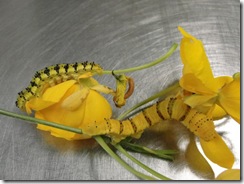
Butterfly gardening has really only been popularized in recent years, so reading DSC01370 50-year-old commentary on caterpillar destruction can be a touch unsettling.The beautiful Cloudless Sulhpur and Orange Barred Sulhpur butterfies host on many species of cassia, including Christmas Cassia (Cassia bicapsularis). Butterfly gardeners today welcome these creatures, but Uncle Pasco disagreed. In the planting guide for April on page 89, he says, “This is the month that most of the insects, pests, etc begin to show up in numbers... For instance those pesky worms appear on... cassia (Cassia bicapsularis)... and look like part of the foliage or flowers. Spray with arsenate of lead.”
Uncle Pasco seems to dislike caterpillars on general principal. The quick and darting Canna Skipper butterfly hosts in the leaves of native and ornamental cannas where it rolls the leaf around itself for protection from predators.  In the February planting guide (p. 86), he tells us, “One of the old time garden favorites that is staging a comeback is the canna... they are very easy to grow but are bothered however with leaf-rollers that cut good sized holes in the leaves. This may be controlled with a Chlordane dust.”

Not surprisingly, every pesticide Uncle Pasco recommends is now banned or not used in the United States. Chlordane was a carcinogenic insecticide that has not been sold in the United States since 1983; arsenate of lead was banned in 1988. He also recommends Nemagon (banned in 1975), Toxaphene (banned in 1986), and explains the proper application of DDT for flea control.

Lessons Learned: It’s important to remember that we can’t blame Uncle Pasco Roberts for his advice. A number of the species he suggests were also found listed in an article by the Florida State Horticultural Society from 1951 entitled Ornamental Trees, Shrubs, and Vines for South Florida Homes by Frank J Rimoldi. Clearly, this was the sort of information that was available to new Florida residents in the 1950’s and 1960’s, and they didn’t know then what we know now. The gardeners of 50 years ago had no idea how out of control their plantings could become. No one meant to destroy native habitats, or apply pesticides that would cause cancer, but lack of knowledge caused widespread and far-reaching damage.

What should we as modern gardeners learn from Uncle Pasco? Perhaps the most important thing to understand is that we all must become more considerate and thoughtful gardeners. We should learn more about the plants we choose to put in our yards, and think about what will happen when we’re no longer there to take care of them. Mexican Petunia is tempting at the nursery with its fast-growth habit and numerous pretty purple flowers, but this Category I invasive is displacing native wild petunia (Ruellia humilis) used by Buckeye caterpillars as a host plant, and it’s nearly impossible to remove once established in a yard due to its deep root system and aggressive seed distribution. Florida-Friendly Gardeners are learning to consider native plants when possible and carefully investigate non-native species before introducing them into the ecosystem.

It’s really about a return to common sense. If we can avoid chemicals in the garden, we should, whether the EPA tells us they’re safe or not. Today’s “safe pesticide” is tomorrow’s DDT. When chemicals like pesticides and fertilizers are necessary, we can use them sparingly, rather than applying them widely and regularly regardless of need. Rather than looking for fast results, which Uncle Pasco and the new Florida residents of 50 years ago desired, we can plan for the future and work toward a yard worth having and enjoying - safely.

Uncle Pasco teaches us to learn from the past. As Dr. Dale E. Turner said, “Some of the best lessons we ever learn are learned from past mistakes. The error of the past is the wisdom and success of the future.” We don’t need to cast blame on Uncle Pasco and his contemporaries, but we can certainly see where they went wrong and try to avoid similar mistakes in the future.

Wednesday, April 14, 2010

That's Good, That's Bad

For several years, My Florida Backyard has been trying to identify the mystery tree in our front yard. This week, we finally succeeded - by following our nose (it always knows!).


It turns out our tree is a Camphor tree (Cinnamomum camphora). While there are plenty of good things about it, there is one major downside - this tree is a Category I invasive tree in the state of Florida. If we were really responsible and dedicated to Florida-Friendly gardening, we'd get rid of it.

But we're not going to.

First, a few facts about the Camphor tree. It's native to East Asia and was brought here to be cultivated for the oil it produces, which has medicinal properties (something you know if you've ever put Campho-Phenique on a mosquito bite or cold sore). Farmers found it wasn't really commercially viable here - the tree only grows half as tall as it does in its native region, and China and Japan had really cornered the market already anyway. The tree gradually shifted to being sold for residential use, and now you'll find some in most neighborhoods throughout the state. It is a deciduous tree, but it does not lose its old leaves until it's already grown new ones, leaving you with a pretty mix of new spring green and older growth dark green leaves for a few weeks, as shown in the picture. At the same time it produces new leaves, it begins to flower, followed by a profusion of black berries later in the year. A very easy way to identify this tree (and one we finally thought to try after several puzzling years) is to crush and smell the leaves - the camphor odor is unmistakable. In the warmer months, it serves as a host plant for the beautiful Spicebush Swallowtail butterfly.

So what's all the fuss about? Camphor tree is very invasive in Florida, which means it has escaped controlled cultivation and is known to be pushing out native plant species needed by our native animals. If you're committed to native Florida gardening, you really shouldn't keep it in your yard - the seeds are easily spread by birds to other areas. According to the Center for Aquatic and Invasive plants, in nearby Polk county the camphor tree is pushing out the native Florida jujube (Ziziphus celatus), relegating it to endangered status. As responsible gardeners trying to make our yard as native as possible, we really should remove this tree.

But... Our tree was probably planted when the house was built, about 25 years ago. It's well-established and provides much-needed shade on the west side of the house. To remove it and plant a new tree would leave an ugly gap that would take many years to fill. Plus, though we've never seen a Spicebush Swallowtail butterfly in My Florida Backyard, it's quite possible they use the upper branches to lay eggs out of sight of the puny humans.

So, we're going to live with the guilt, and with the camphor tree, at least for now.

Tuesday, April 13, 2010

Don't Fence Me In

My Florida Backyard occasionally experiences pest problems - specifically pests with two legs and no concept of property line boundaries. I'm speaking of course of some of the neighborhood children, who sometimes like to use the gardens in our yard as their own personal short cuts. While we're definitely not the old, cranky "keep off my lawn" kind of people (we really don't care if kids run on the little bit of grass left in the front yard), we definitely don't like it when careless kids trample our precious plants.

So, we've decided to try a bit of a physical barrier in the part of the yard that receives the most unwelcome traffic. We wanted a fairly low-cost solution, and we didn't want something that would block our own view of the lake, so we went with this resin "snap-together" fencing from Home Depot. It's just  high enough that you can't step over it easily, but unobtrusive enough that we don't notice it much.

It also has the advantage of serving as support for one of our new additions, purchased at the USF Spring Plant Sale this past weekend.


This new resident is a Dutchman's Pipevine, specifically Aristolochia trilobata. We've been wanting some pipevine in My Florida Backyard for quite some time now, as they serve as a host plant for both Pipevine Swallowtails and Polydamas Swallowtails. With any luck, we'll have some caterpillars on this vine this summer.

A. trilobata is a neat vine, with its shiny tri-lobed leaves and crazy interesting flowers (see below) that explain the "pipe" part of the name. It will die back to the ground in a freeze, but recovers well once the weather warms up. We were pleased to find such a healthy, full plant for sale, because it won't take a few caterpillars long to chomp the leaves up pretty well.

We've only had the new fence up a few days, so it's hard to say if this will completely stop the unwanted kid traffic. But if nothing else, it provides a great low trellis for a vine that should add a lot of wildlife value to My Florida Backyard, and that's something we can feel good about.

Friday, November 20, 2009

Froggy Bottom

We experienced a little problem when trying to use the watering can the other night - it appears someone had taken up residence in the spout.
This froggy little fellow is most likely a Cuban Treefrog. Two identifying features are the large "toepads" and the bumpy skin. As the name might indicate, it comes from Cuba as well as the Bahamas and Cayman Islands. Like so many introduced species, the Cuban Treefrog is considered invasive in Florda. It feeds on a variety of creatures, including native treefrogs and other Cuban treefrogs (cannibal frogs!).

In a true Florida-Friendly Yard, it's best to eradicate invasive species when you find them. If we'd realized this was a Cuban Treefrog when we first found it, we could have eliminated it from the environment permanently. In other words, we should have killed the little bugger. The University of Florida IFAS Extension provides instructions for doing this humanely (it involves your freezer). It's hard for a wildlife lover to extinquish any kind of life (here we go with the euphemisms again), but it takes hard choices to help protect the environment and ecosystem.

Fortunately, the IFAS Extension also provides some easy instructions on how to make Treefrog Houses to lure native treefrogs to your yard. It's as simple as driving a piece of PVC pipe into the ground in a nice place among some plants or trees. The treefrog house, like a toad house, provides a shady place for treefrogs to hide out during the day, where they can be protected from predators such as stray cats. We plan to install some of these in My Florida Backyard very soon - we'll post pictures when we do.

Wednesday, October 28, 2009

One Piece at a Time

It's been unseasonably warm here in My Florida Backyard, and we haven't been getting as much outside time as we might like. We're getting all the moist heat of the summer with very little of the beneficial afternoon rain. Temps are running 5-7 degrees among normal, with days approaching record highs of near or at 90. Still, it beats snow, sleet, and nasty north winds, so we're trying not to complain - much.

Still, I try to get out each day for at least a little stroll around the yard, to check on everyone and plan maintenance and improvements for when the weather finally cools off. Today, I was pleased to notice that the new Mexican Petunia plants I started a few weeks ago are doing well.

I've written my thoughts about Mexican Petunia before - the only way it belongs in a Florida-Friendly yard is if you use a sterile cultivar. That is, of course, what we have, so the plants don't spread unless we want them to. You might think that means that when I want new plants, I have to buy them, since these plants produce no seeds. Fortunately, Mexican Petunia has to be one of the absolute easiest plants to start from cuttings.

In fact, "start from cuttings" makes the process sound more complicated than it is. All I did to start this new set of plants was to break off a piece of an existing plant at a joint, where it forms a sort of square. Then, I used a stake to make a narrow deep hole and shoved the "cutting" down into the soil. I watered them in well, and watered them once a week or so - when I remembered.

They looked a little wilty for the first day or two, but now they're beginning to establish roots and starting to thrive. By this time next year, my new plants should be reaching the heights of the older ones, creating a nice border between our property and the neighbors - all at no additional cost to me.

Mexican Petunias (Ruellia brittoniana) are both a blessing and a curse to Florida gardeners. They're easy to grow, produce flowers during much of the year, and are readily available at any local nursery - that's good. But the non-sterile cultivars produce seeds and spread at a prodigious rate; they can easily choke out other plantings and become impossible to eradicate - that's bad. So once again, I have to say - if you want them, look for those marked "sterile cultivar". It's the only responsible thing to do.

P.S. There is a similar native plant out there, by the way. Just this weekend, I was able to buy a very healthy looking Wild Petunia (Ruellia caroliniensis) at my favorite native plant nursery. It only grows to about 12 inches, as opposed to the 5-6 foot range of the Mexican Petunia, and the purple flowers are a bit smaller. They are just as attractive to butterflies, if not more so, and serve as a host plant for Buckeye butterfly caterpillars. If you have the chance to buy Wild Petunia instead of Mexican Petunia, you should certainly do so.

Monday, September 28, 2009

The Ants Go Marching

We love most bugs in My Florida Backyard. In general, they're part of a healthy balanced garden, and can often be fascinating to watch.

And then there are fire ants.

Ants are amazing creatures. Their colonies and work ethics are beyond compare in the animal kingdom - I have no doubt that given the opportunity, ants could take over the earth and probably run it better than we do. For the most part, I admire ants.

So why do we in My Florida Backyard feel so differently about fire ants? Perhaps this picture of a fire ant queen and some of her minions can begin to answer the question...

Still not convinced?

Fire ants are an invasive species in Florida. Originally from Argentina, fire ants were accidentally introduced to the U.S. in 1918. Since then, they've spread throughout most southern states. They have no natural controls here, so they've been able to proliferate unchecked.

Fire ants are aggressive. If you step on a mound accidentally, they will attack in force. I can understand the need to defend your home, but honestly, these guys are nasty. The bite is painful at first, and then insanely itchy. Some people (including yours truly) swell up around the bite site, and suffer from the bites for days afterward.

Fire ant colonies build enormous unsightly mounds that deface your landscaping. Case in point:

Once they show up in your yard, they can be pretty hard to get rid of. Even harsh chemical treatments are only effective temporarily. Unless you choose to treat your entire yard every couple of weeks (which is horrifyingly bad for the environment), you're going to get occasional fire ant infestations in Florida.

General "Green" Pesticide Rules:
  • It's always best to use pesticides reactively rather than proactively. On other words, treat only when you discover the problem.
  • Always treat as minimally as possible to eliminate the pests. More is not always better.
  • When you can, use treatments approved for organic gardening, as they are generally better for the environment.
  • Find a treatment that attacks only the specific pest you have. It's not desirable to kill every insect in your garden; in fact, that's usually the worst thing you can do.
  • Always leave a "buffer zone" if you live on the water. Experts recommend avoiding pesticide and fertilizer applications within 30 feet of water to avoid runoff contamination.
All of that being said, what fire ant treatments can environmentally-conscious gardeners use? Well, as always, you're not going to find effective "green" treatments at the big box stores, so it's best to try local eco-friendly nurseries. If you can't find what you need locally, you can go online. Clean Air Gardening offers organic fire ant treatments - we like Green Light Fire Ant Control. They also offer details on less toxic ways to deal with these demon creatures.

Fire ants are a fact of life in My Florida Backyard. Because of them, I always garden in jeans with shoes and socks - the less skin I expose, the less likely I am to be bitten. But for the most part, they don't keep me from enjoying the year-round pleasures of the great Florida outdoors - and that's what's important.

Wednesday, July 8, 2009

Live and Learn

On July 7, My Florida Backyard hosted the second meeting of the Greenbrook/Brightside Adopt-A-Pond Project. John McGee, Hillsborough County Adopt-A-Pond program coordinator, was on hand to provide us with lots of information and materials to get our project up and running.

We were also fortunate to have on hand John Calvert, Plantation's new property manager, and Danny Church, Plantation's maintenance supervisor. We need the support of the whole community to make this project succeed, and John and Danny understand the positive impacts our planned improvements will have on Plantation as a whole.

John (McGee) began the evening by giving us an overview of stormwater ecology, and then asked us what our goals are as we begin work on our pond. Several of us listed the desire to create new wildlife habitats and improve the existing ones. Danny indicated it would be great if this program could help to stop erosion of the pond banks. We also discussed the possibility of maintaining water quality while using fewer chemical herbicides. John assured us all of these goals were very possible.

He then moved on to explaining the materials he brought to support our efforts. The most important is the giant Adopt-A-Pond Notebook. This book contains just about every kind of information we could need, including forms, program information, pictures and detailed description of plants, and a landscaping guide. Paula will hold onto one copy of this notebook, and Danny will receive another to be used as our group cooperates with the maintenance team to make the project successful.

John also brought copies of the Adopt-A-Pond brochure, stickers, and several reference books, as well as print copies of the Adopt-A-Pond newsletter, On Our Pond.

The group spent some time addressing concerns that while residents may work to establish new plants and habitats in and around the pond, well-meaning maintenance crews could inadverdently spray herbicides that would destroy all the hard work. Danny assured us that he would work with us and his crew to ensure that our pond maintains maximum health levels while protecting the efforts of the Adopt-A-Pond team. Danny explained that one of the main pond issues is controlling the very invasive Hydrilla. John explained some possible alternatives to the current methods, including the possibility of introducing a carefully controlled population of Chinese Grass Carp. We will explore these ideas further as the project progresses.

Finally, the group was ready to make some plans for moving ahead with the project. We agreed to focus our initial efforts on the playground area at the north end of the pond, where we can work to control erosion as well as establish wildlife habitat. John suggested he visit the area and choose the best plants (all native to Florida) to start the project off right, and we agreed. Some of the plants he may help us introduce include:
Our first planting is planned for Wednesday, August 12, from 6:00 - 8:00. John will be there to guide us every step of the way, so no experience in any kind of planting is required. All residents are encouraged to join in! We'll meet at the playground area. Be sure to dress in clothes that can get wet and muddy, and bring a long-handled pointed shovel if you have one.

Study nature, love nature, stay close to nature. It will never fail you.
-Frank Lloyd Wright

Friday, April 17, 2009

Mexican Hat Dance

While filling my watering can from the rain barrel this afternoon, I stopped to admire the Mexican Petunias thriving along the fence (well, my neighbor's fence, but my petunias). Their happy purple blooms were drawing bees in the late afternoon sun, and they danced in the breeze blowing from the lake. What a great flower for Florida - hardy, drought-tolerant, easy to care for - everyone should have these in their (screech! "Hey, what's going on? Give back my microphone! This is my blog! What are you doing?" screech!)

LADIES AND GENTLEMEN, THIS INTERRUPTION IS BROUGHT TO YOU BY THE EMERGENCY BROADCASTING SYSTEM...OF INVASIVE PLANTS. WE ARE HERE TO TELL YOU THAT MEXICAN PETUNIA IS HIGHLY INVASIVE AND IS LISTED AS A CATEGORY 1 INVASIVE SPECIES BY THE FLORIDA EXOTIC PEST PLANT COUNCIL. DO NOT LISTEN TO ANYTHING THIS PERSON IS TELLING YOU. MEXICAN PETUNIA IS INVASIVE AND MUST BE AVOIDED IN FLORIDA-FRIENDLY GARDENS. THAT IS ALL.

Geez, guys, you didn't give me a chance to finish! You're absolutely right. Mexican Petunia (Ruellia brittoniana) is absolutely an invasive species in Florida. Even though you find it at nearly every nursery, especially the big box stores, Mexican Petunia is actually a terrible plant for a Florida-Friendly yard.

What is an invasive species, anyway? Simply put, an invasive species is one that is not native to the area, but thrives here to the detriment of local species. Some non-native plants are fine, because they're easy to control or don't complete with local species. But an invasive plant is a real problem, because it takes over the environment, with little or no help from humans, and spreads like crazy. If you want to learn more, click on over to the Florida Invasive Plant Education site.

So why the heck would I have terribly invasive non-native Mexican Petunias in My Florida Backyard? Here's why: I use a sterile cultivar of this plant. This means that the plant has been cultivated so that it can't propagate on its own. The MPs I plant in my yard will stay only in my yard, and will not spread out of control. The only place I've been able to find this sterile cultivar Mexian Petunia (believe it or not!) is at my local Home Depot nursery. They sell plants from Riverview Flower Farm (the ones that come in the green pots).

Here's the deal: If you have Mexican Petunia in your yard, and you don't know whether it's sterile or not, then it's probably not. I highly recommend you pull it out, all of it, and replace it with something more Florida-Friendly. You could try the Wild Petunia, which is similar, but I have to admit I didn't have much luck with it. Or look for something completely different - remember to try the Florida Friendly Plant Database.

Or, if you want, try the sterile cultivar. I've had luck with it, and after a year, it has not spread beyond where I've planted it. It does get a little...broad - in order to keep it from drooping out onto the path, I tie it up to bamboo stakes. I think it makes a responsible addition to My Florida Backyard, and I'm glad we have it.