Our screened-in back porch is probably our favorite part of the house here in My Florida Backyard. It gives us a place to sit and watch the wildlife world go by without being eaten alive by mosquitoes or drowned in the rain. In turn, the outside of the screen gives wildlife a place to hang out - lizards spend time there warming up in the sun, squirrels race across it on their way from one feeder to another, and insects rest there before heading back out into the world, like this furry brown moth we found the other day:
The world is full of PBMs - "plain brown moths", most of which are extremely difficult to identify, but the fun furry legs on this one led us to try anyway. We started at DiscoverLife.org's Moth ID guide, which allows lets you check boxes and narrow down your options, but we still got too many possibilities. We tried some Google searches for things like "furry brown moth", but again - no luck. In the end, we found it by dumb luck while browsing brown moth images. It's a Florida Fern Moth (Callopistria floridensis), whose caterpillars feed on many kinds of ferns, and its native to Florida and the tropics.
Small discoveries like this aren't exciting to everyone, but they make days in My Florida Backyard a little more fun for us. Time spent on our back porch is never time wasted!
An online journal of our quest to make a tiny piece of Florida suburbia into a wildlife-friendly oasis.
Showing posts with label moths. Show all posts
Saturday, November 12, 2011
Tuesday, August 23, 2011
Look Alike
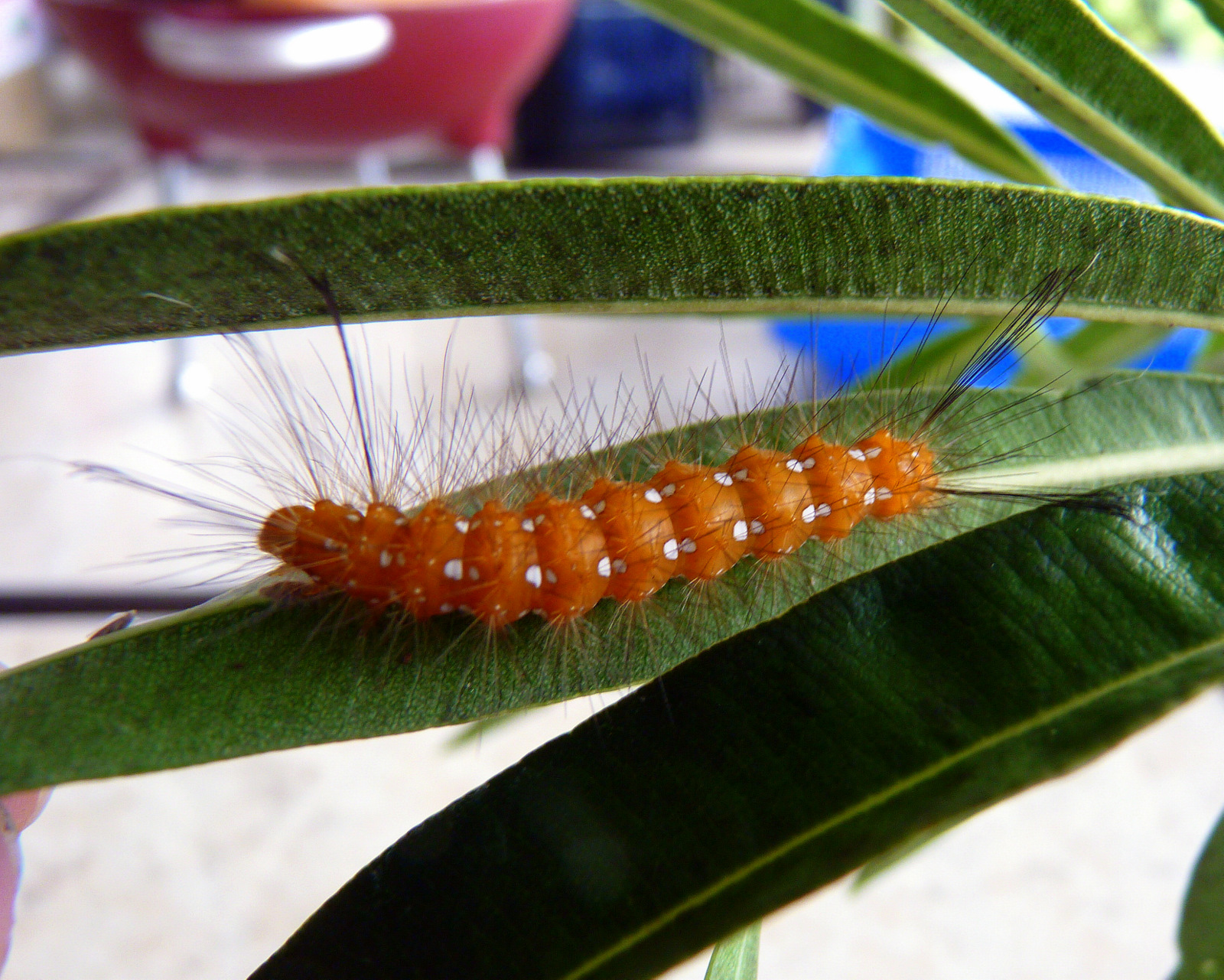
Things always seem to slow down in the garden in August. It's so very very hot, with rain nearly every day, and we don't always seem to get out to see what's going on like we do in the cooler months. There's still plenty of activity, though, as we found when we turned over the oleander leaves and discovered some new caterpillars the other day.
Polka dots! We knew pretty quickly what these caterpillars were likely to be. Last year, we posted about the Spotted Oleander Moth (Empyreuma affinis), a Caribbean species that has been moving its range steadily north for the last 30 years or so. It feeds, as should be extremely obvious, on oleander (Nerium oleander).
The Spotted Oleander Moth is similar in appearance to the Common Oleander Moth, also called the Polka-Dotted Wasp Moth (Syntomeida epilais), both as adult moth and and as a caterpillar. The common oleander caterpillar is familiar to anyone who has oleander in their yards, as a bright orange caterpillar with black spiky hairs (click here to see a picture). The Spotted Oleander Moth caterpillar is also orange, but with white spots and mostly white hairs, with longer black hairs at the front and back.
All parts of the oleander plant are very toxic, so it seems likely that any caterpillars that feed on it would be toxic as well. The bright coloring of the spotted oleander caterpillar is a good indicator of that danger - it's a form of defense called "aposematism". These bright colors basically indicate to possible predators that the organism in question is likely to make them sick if eaten. The hairs of this caterpillar, or setae, are harmless to humans, but likely very irritating to anything trying to ingest it.
The common oleander caterpillar is a known pest on oleander plants, but the spotted oleander caterpillar shown here is not considered to be as destructive as they are not as gregarious. We found only three altogether on our oleander plants, so that seems true.
Not that it matters to us. Since our yard is designed to attract wildlife, we rarely consider any new creatures to be pests in My Florida Backyard. This recent find was a good reminder that summer heat doesn't keep wildlife from visiting the garden, and it shouldn't keep us from visiting either!
Wednesday, November 3, 2010
You Hit the Spot
Recently, My Florida Backyard has been visited by a moth that seems to be a little out of its range: a Spotted Oleander Moth (Empyreuma affinis). Like all Lepidoptera, they don't really like to hold still for pictures, but we managed to snap a few to help us with identification.
The Spotted Oleander Moth is part of a group known commonly as Wasp Moths (taxonomic subtribe Euchromiina). Although they resemble wasps in shape, they do not sting or bite - though most predators probably don't realize that. They are diurnal, meaning they fly during the day, unlike many other moths which are nocturnal.
The Spotted Oleander Moth is native to the Caribbean region. It's only been found in Florida for the last 30 years or so, and is seen primarily in the Keys and South Florida. We could find only one other reported sighting in Central Florida, and it was as recent as last month. Perhaps this species is starting to populate further north?
As its name suggests, the caterpillar of this species feeds on Oleander (Nerium oleander), a non-native flowering shrub frequently used in landscaping across the state. We don't grow any oleander in My Florida Backyard, but there's plenty of it in the neighborhood, and the relatively frequent sightings of this insect lately lead us to believe there is a breeding population locally.
A similar and more prevalent species in Central Florida is the Common Oleander Moth, also known as the Polka-Dot Wasp Moth (Syntomeida epilais), whose caterpillar is often considered a pest on oleander due to its habit of defoliating the plant very quickly and efficiently. The Spotted Oleander Moth is considered less destructive, probably because it is less common.
If you've noticed the Spotted Oleander Moth in your Central Florida yard, let us know in the comments. We're interested in finding out how prevalent this species is becoming in the area.
The Spotted Oleander Moth is part of a group known commonly as Wasp Moths (taxonomic subtribe Euchromiina). Although they resemble wasps in shape, they do not sting or bite - though most predators probably don't realize that. They are diurnal, meaning they fly during the day, unlike many other moths which are nocturnal.
The Spotted Oleander Moth is native to the Caribbean region. It's only been found in Florida for the last 30 years or so, and is seen primarily in the Keys and South Florida. We could find only one other reported sighting in Central Florida, and it was as recent as last month. Perhaps this species is starting to populate further north?
As its name suggests, the caterpillar of this species feeds on Oleander (Nerium oleander), a non-native flowering shrub frequently used in landscaping across the state. We don't grow any oleander in My Florida Backyard, but there's plenty of it in the neighborhood, and the relatively frequent sightings of this insect lately lead us to believe there is a breeding population locally.
A similar and more prevalent species in Central Florida is the Common Oleander Moth, also known as the Polka-Dot Wasp Moth (Syntomeida epilais), whose caterpillar is often considered a pest on oleander due to its habit of defoliating the plant very quickly and efficiently. The Spotted Oleander Moth is considered less destructive, probably because it is less common.
If you've noticed the Spotted Oleander Moth in your Central Florida yard, let us know in the comments. We're interested in finding out how prevalent this species is becoming in the area.
Thursday, July 15, 2010
Beautiful Ohio
My Florida Backyard has been on its own for the last week, as its owners have been up north for a family wedding. As you might expect from a Florida garden in the summer, we returned to a serious jungle situation, especially since we received about 8 inches of rain in the 10 days before we left. Weeds are rampant, grass is knee-high, and the work ahead of us feels a little daunting.
On the plus side, we managed to squeeze in a little time in Ohio to visit the Secrest Arboretum in Wooster, a part of The Ohio State University's OARDC. Mid-July is probably the best time of the year in an Ohio garden, and we were able to enjoy some of the best flowers the state has to offer. Until My Florida Backyard is back in shape, we thought you might enjoy seeing what's in bloom up north right now.
Shasta daisies (Chrysanthemum maximum):
Hummingbird Clearwing Moth (Hemaris thysbe) enjoying Bee Balm (Monarda):
Rose of Sharon (Hibiscus syriacus) is part of the hibiscus family, so we felt almost at home:
Columbine (Aquilegia hybrida), which unfortunately doesn't grow well in Florida:
A massed planting of Verbena bonarensis:
The arboretum also includes woodland trails and an outdoor amphitheater:
No butterfly lover would be happy without a new sighting on a trip. We saw our first Question Mark (Polygonia interrogationis), named for the small white marking on the lower hindwing.
On the plus side, we managed to squeeze in a little time in Ohio to visit the Secrest Arboretum in Wooster, a part of The Ohio State University's OARDC. Mid-July is probably the best time of the year in an Ohio garden, and we were able to enjoy some of the best flowers the state has to offer. Until My Florida Backyard is back in shape, we thought you might enjoy seeing what's in bloom up north right now.
Purple coneflower (Echinacea purpurea):
Shasta daisies (Chrysanthemum maximum):
Hummingbird Clearwing Moth (Hemaris thysbe) enjoying Bee Balm (Monarda):
The variety of day lilies and Asiatic lilies is astonishing:
Rose of Sharon (Hibiscus syriacus) is part of the hibiscus family, so we felt almost at home:
Columbine (Aquilegia hybrida), which unfortunately doesn't grow well in Florida:
A massed planting of Verbena bonarensis:
The arboretum also includes woodland trails and an outdoor amphitheater:
No butterfly lover would be happy without a new sighting on a trip. We saw our first Question Mark (Polygonia interrogationis), named for the small white marking on the lower hindwing.
Ohio is truly beautiful in the summer, and we're glad we had a chance to enjoy it. Now we're back home, ready to tackle the jungle that used to be our yard. Florida is beautiful in summer too, once you get all the weeds out of the way!
Labels:
butterflies,
fun,
landscaping,
moths,
plants,
wildlife
Sunday, June 13, 2010
Who Am I?
We're pretty familiar with our butterfly caterpillars in My Florida Backyard. We know what plants to expect them on, and what the more common ones look like. If we come across one about which we're unsure, we can always look it up in our favorite caterpillar ID book: Florida Butterfly Caterpillars and Their Host Plants. This book not only has great pictures of caterpillars, but it lists host plants and the butterfly caterpillars who use them.
Moth caterpillars, on the other hand, pose more of a problem. Many moths host on a variety of plants, so it can be difficult to narrow down based on the plant where you find them. There are a huge variety of moths, and most are only active at night, so it's rare to actually see them ovipositing, which is another easy way to ID them. So, these caterpillars are a mystery to us right now:
We discovered these caterpillars eating some pink Swamp Milkweed (Aesclepias incarnata 'Cinderella') we've been trying to start from seed. We've been picking off all the monarch cats and transferring them to tropical milkweed (Aesclepias curassavica) to give the incarnata a chance to get started. That's when we found these fellows.
A little while later, we found some eating some bean leaves too. What the heck kind of caterpillar eats beans and milkweed? We have no idea, but one of the easiest ways to find out can be to raise them in captivity and see what they turn into. So that's what we're doing. We've brought a few in and are raising them in a rearing tank, to see what might happen. They're really interesting little creatures. They feel soft and almost velvety and in bright light, you can see a red and white stripe down the side of their reddish-brown bodies.
So, if you happen to know what these little guys are, please let us know. Otherwise, we'll just keep feeding them and see where their life cycle takes them!
Moth caterpillars, on the other hand, pose more of a problem. Many moths host on a variety of plants, so it can be difficult to narrow down based on the plant where you find them. There are a huge variety of moths, and most are only active at night, so it's rare to actually see them ovipositing, which is another easy way to ID them. So, these caterpillars are a mystery to us right now:
We discovered these caterpillars eating some pink Swamp Milkweed (Aesclepias incarnata 'Cinderella') we've been trying to start from seed. We've been picking off all the monarch cats and transferring them to tropical milkweed (Aesclepias curassavica) to give the incarnata a chance to get started. That's when we found these fellows.
A little while later, we found some eating some bean leaves too. What the heck kind of caterpillar eats beans and milkweed? We have no idea, but one of the easiest ways to find out can be to raise them in captivity and see what they turn into. So that's what we're doing. We've brought a few in and are raising them in a rearing tank, to see what might happen. They're really interesting little creatures. They feel soft and almost velvety and in bright light, you can see a red and white stripe down the side of their reddish-brown bodies.
So, if you happen to know what these little guys are, please let us know. Otherwise, we'll just keep feeding them and see where their life cycle takes them!
Tuesday, January 26, 2010
Buried Treasure
While replanting some pots out front, we discovered some buried treasure:
What the heck is it, you might ask? Why, it's a sphinx moth cocoon, I reply. It's quite big, several inches long and thicker than my thumb, and the segmented end tends to wiggle when you touch it. The "handle" on the right side is actually a sheath protecting the developing proboscis - that certainly gives you an idea of the size of the moth that will emerge.
(Quick Fact: In general, moths bury themselves and pupate as a cocoon, while butterflies suspend themselves from a silk pad and pupate as a chrysalis. Interestingly, most 5-year-olds know this, but most adults do not!)
Since we didn't see the caterpillar, we can't be certain which type of sphinx moth will eventually emerge from this cocoon. Moths pupate much longer than most butterflies, and it could be weeks or months until he shows his colors. We're keeping him safe in a jar on the back porch and will post pictures when the time comes!
Subscribe to:
Posts (Atom)