
Showing posts with label wildflowers. Show all posts
Showing posts with label wildflowers. Show all posts
Sunday, March 31, 2013
Springtime Snapshot
Whether you're celebrating Easter today or just enjoying spring, we hope your day is as lovely as ours here in My Florida Backyard!


Tuesday, December 4, 2012
Right Where I Belong
Last Tuesday, I teased you with some mystery flowers in my Home Depot shopping cart. I certainly didn't intend for it to take a week for me to get back to you with the answer, but isn't it funny how life just gets away from you? Work, errands, holiday planning, more work... well, anyway, I finally found time to plant my precious flowers and now I proudly present to you my very favorite Florida native wildflower: Tampa Mock Vervain (Glandularia tampensis)!
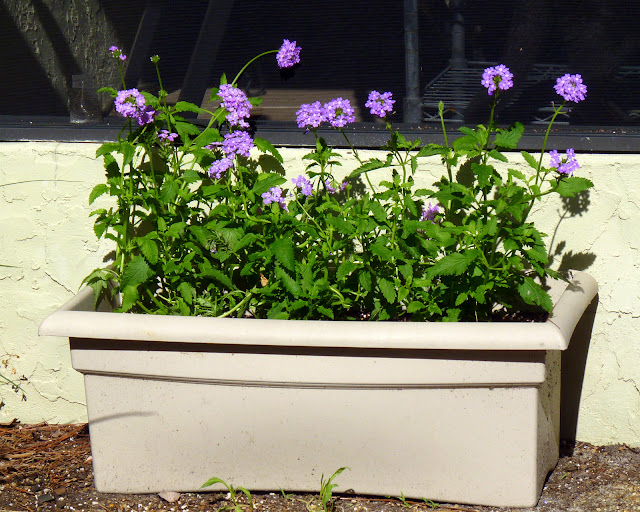
Not every town has a flower named after it, but Tampa does, and it's a lovely one at that. Endemic to just a handful of counties along the western coast of Florida, Tampa Mock Vervain is endangered mostly due to habitat loss. Fortunately, it's generally available at Bay area Home Depot stores this time of year, as well as at just about any local native plant nursery. It will bloom happily until the hot summer hits around June, so now is the time to plant it. (Learn more about Tampa Mock Vervain in this post from last year.)

It's been extraordinarily dry here for the last six weeks or so, with virtually no rain and none in the forecast either. Although Tampa Vervain is drought-tolerant, it will flower best with regular water, so I decided to plant mine in containers this year. That way, I have more control over the watering and can effectively use what's left in our rain barrel before resorting to the hose. I found these little rock planters on clearance at the end of the summer and have been looking for a good chance to use them, so this is perfect timing!
So why do I love Tampa Vervain so much? Aside from the glorious purple flower clusters (I can never capture the color just right with my camera) and the fact that planting it helps support an endangered species named for the city where I live? Well, the answer to that is easy...


Butterflies love it! Really, there's no downside to this plant. It deserves a place in every cool-season butterfly garden in Central Florida... and My Florida Backyard is happy to have it once again!

Not every town has a flower named after it, but Tampa does, and it's a lovely one at that. Endemic to just a handful of counties along the western coast of Florida, Tampa Mock Vervain is endangered mostly due to habitat loss. Fortunately, it's generally available at Bay area Home Depot stores this time of year, as well as at just about any local native plant nursery. It will bloom happily until the hot summer hits around June, so now is the time to plant it. (Learn more about Tampa Mock Vervain in this post from last year.)

It's been extraordinarily dry here for the last six weeks or so, with virtually no rain and none in the forecast either. Although Tampa Vervain is drought-tolerant, it will flower best with regular water, so I decided to plant mine in containers this year. That way, I have more control over the watering and can effectively use what's left in our rain barrel before resorting to the hose. I found these little rock planters on clearance at the end of the summer and have been looking for a good chance to use them, so this is perfect timing!
So why do I love Tampa Vervain so much? Aside from the glorious purple flower clusters (I can never capture the color just right with my camera) and the fact that planting it helps support an endangered species named for the city where I live? Well, the answer to that is easy...


Tuesday, November 27, 2012
Tuesday Trivia: What's In My Cart?
I took a break from a marathon Christmas shopping trip this afternoon to see what was new at my local Home Depot nursery. I wasn't going to buy anything (I swear!), until I spotted a sea of light purple from afar and went running over to see if it could possibly be what I thought it was. And it was! I quickly loaded the cart:


Know what it is? It's my favorite Florida native wildflower, and this is the time of year when you can find it for sale. If you can't ID it, come back this weekend when I'll be posting about planting it and a few other things! Happy guessing!
Wednesday, May 30, 2012


Monday, May 21, 2012
Ro Ro Rosy
We love exploring the shore of our pond, looking for new wildflowers we haven't noticed before. Today's discovery is Rosy Camphorweed (Pluchea baccharis).

The Latin name "baccharis" means "fragrant root", although it doesn't really specify just how pleasant the fragrance is. A quick sniff of the crushed foliage will make the origin of the common name obvious immediately, though the flowers have a light sweet smell and are a draw for small butterflies and other pollinators.

Rosy Camphorweed is a plant of the wetlands. It requires consistently moist soil and can tolerate occasional salt exposure. It grows anywhere from one to three feet in height, and is found throughout the southeast U.S. You might find it for sale at native plant nurseries, especially those that specialize in wildflowers. Now that we've identified it, though, we're noticing it all over the place, so take a look around... maybe you'll find some in your own backyard!

The Latin name "baccharis" means "fragrant root", although it doesn't really specify just how pleasant the fragrance is. A quick sniff of the crushed foliage will make the origin of the common name obvious immediately, though the flowers have a light sweet smell and are a draw for small butterflies and other pollinators.

Monday, March 5, 2012
Rose Tint My World
It's no secret that we love salvia in the My Florida Backyard butterfly garden, and native Salvia coccinea is our favorite. It reseeds freely, grows in pretty much all conditions, and draws butterflies like a magnet. In recent years, new cultivars of this species have become available, as growers work to provide us with a wider range of colors than the original (and still beloved) red. 'Snow Nymph' offers white flowers, while cultivars like 'Coral Nymph' and 'Summer Jewel Pink' come in different shades of pink.
All this mixing and hybridizing means that some interesting in-between shades sometimes pop up, like this pretty deep rose color we found a few weeks ago at Wilcox Nursery in Largo.


This shade is different than the other S. coccinea varieties that we've found, and it's hard to know if it will set seed or continue to flower in this deep pink hue. But another salvia never goes unappreciated in the butterfly garden, no matter what the color, and we're always glad to have more in My Florida Backyard!
All this mixing and hybridizing means that some interesting in-between shades sometimes pop up, like this pretty deep rose color we found a few weeks ago at Wilcox Nursery in Largo.


This shade is different than the other S. coccinea varieties that we've found, and it's hard to know if it will set seed or continue to flower in this deep pink hue. But another salvia never goes unappreciated in the butterfly garden, no matter what the color, and we're always glad to have more in My Florida Backyard!
Friday, March 2, 2012
Bet Your Bottom Dollar
And suddenly, it's March. How the heck did that happen? It eases in so quietly down here in Florida, especially this year when everything is blooming weeks early and the temperatures have been far above average all winter. At any rate, all of a sudden March is here, and nothing really has an excuse for laying low anymore. Our front yard is full of the in-your-face color of hippeastrum, trees are showing off spring green leaves (and plenty of pollen), and the butterflies are out in force, with Giant Swallowtails, Spicebush Swallowtails, and Tiger Swallowtails all flashing their wings against the blue sky.
Amidst all of this is when I sometimes really like to just look down for a minute and admire the smallest things, like the flowers of the Dollarweed (Dichondra micrantha) growing in the backyard. Some call Dollarweed a noxious weed and try to eliminate it; others choose to use it as groundcover. We're not fond of turf grass in My Florida Backyard, of course, so we can just enjoy the adorable little flowers of dollarweed without worry.


In spring, we really have to agree with Ferris Bueller of movie fame, who famously stated, "Life moves pretty fast. If you don't stop and look around once in a while, you could miss it." That's what we try to do in My Florida Backyard!
Amidst all of this is when I sometimes really like to just look down for a minute and admire the smallest things, like the flowers of the Dollarweed (Dichondra micrantha) growing in the backyard. Some call Dollarweed a noxious weed and try to eliminate it; others choose to use it as groundcover. We're not fond of turf grass in My Florida Backyard, of course, so we can just enjoy the adorable little flowers of dollarweed without worry.


In spring, we really have to agree with Ferris Bueller of movie fame, who famously stated, "Life moves pretty fast. If you don't stop and look around once in a while, you could miss it." That's what we try to do in My Florida Backyard!
Friday, February 3, 2012
Two Little Flowers
The spring rehabilitation of My Florida Backyard has begun at last! We started small, with our favorite cool season wildflower - it's Tampa Vervain time! Each year, we wait eagerly for Tampa Mock Vervain (Glandularia tampensis) to start showing up at nurseries. Butterflies love it, and it flowers non-stop from now until the hot and humid summer days set in.


We mixed it with another tiny flower that butterflies adore, gold lantana (Lantana camara 'New Gold'). We like this lantana because even though some varieties of L. camara are found on the invasive lists, 'New Gold' is considered sterile and doesn't spread beyond where you plant it.

Purple and yellow is one of our favorite color combinations - together the two just look so happy and spring-like. And this will make a nice little corner for butterflies to visit while we work on the rest of the yard and gardens.

There's plenty more planting ahead this weekend in My Florida Backyard, so drop by in a few days to see the changes!


We mixed it with another tiny flower that butterflies adore, gold lantana (Lantana camara 'New Gold'). We like this lantana because even though some varieties of L. camara are found on the invasive lists, 'New Gold' is considered sterile and doesn't spread beyond where you plant it.

Purple and yellow is one of our favorite color combinations - together the two just look so happy and spring-like. And this will make a nice little corner for butterflies to visit while we work on the rest of the yard and gardens.

There's plenty more planting ahead this weekend in My Florida Backyard, so drop by in a few days to see the changes!
Thursday, October 20, 2011
Don't Be Shy
Here in My Florida Backyard, we're lucky to live on a stormwater drainage pond, part of a huge stormwater management system designed to prevent flooding and filter out contaminants before they can drain into the groundwater. This pond also adds a wetland aspect to our environment, bringing in wading birds, alligators, and water-loving plants we wouldn't have otherwise. We love to check out the shoreline for new sightings, like this cute little wildflower we found the other day.

We pulled out our Wildflowers of Florida Field Guide and found it on the first page of the "yellow flowers" section. It's Shyleaf (Aeschynomene americana), a native plant found in wetlands throughout Florida. It grows about 2 feet by 2 feet, in a rather feathery fashion that reminds us of Partridge Pea.

In fact, both Partridge Pea and Shyleaf are in the Pea Family (Fabaceae), as you can pretty easily tell by looking at the flowers, and by the fact that it spreads by seeds from pods. It prefers moist soil, so it's often found along the edge of lakes and rivers. As you might have guessed from the name, Shyleaf folds up its leaves when touched, and it's a host plant for the Barred Yellow (Eurema daira) butterfly, a fairly small pale yellow butterfly with a green caterpillar.

It's always fun to find a new plant in and around My Florida Backyard, and when it's a native wildflower, that's even better. When you keep your eyes open, you never know what you might find!

We pulled out our Wildflowers of Florida Field Guide and found it on the first page of the "yellow flowers" section. It's Shyleaf (Aeschynomene americana), a native plant found in wetlands throughout Florida. It grows about 2 feet by 2 feet, in a rather feathery fashion that reminds us of Partridge Pea.

In fact, both Partridge Pea and Shyleaf are in the Pea Family (Fabaceae), as you can pretty easily tell by looking at the flowers, and by the fact that it spreads by seeds from pods. It prefers moist soil, so it's often found along the edge of lakes and rivers. As you might have guessed from the name, Shyleaf folds up its leaves when touched, and it's a host plant for the Barred Yellow (Eurema daira) butterfly, a fairly small pale yellow butterfly with a green caterpillar.

It's always fun to find a new plant in and around My Florida Backyard, and when it's a native wildflower, that's even better. When you keep your eyes open, you never know what you might find!
Thursday, October 13, 2011
Georgia on My Mind
Last spring, we bought a neat little native wildflower from Wilcox Nursery over in Largo. We were intrigued by the yummy minty smell at the time, and the promise of hordes of tiny flowers in the fall. Well, fall has arrived, and the Georgia Calamint (Calamintha georgiana) has delivered the promised buds and blooms, the sheer number of which are hard to appreciate in this photograph.

Up close, the flowers resemble those of Florida Pennyroyal (Piloblepis rigida), another native member of the Mint family (Lamiaceae). The flavor and smell of mint from the foliage has a bit of savory spice to it, which is most likely why its other common name is Georgia Basil. Some write of using this plant as seasoning or for teas.

Our plant is fairly small still, though it's said to grow 2 feet high by 3 feet wide. This species is actually not really found in the wild this far south, though it's common a little further north, including (as you might guess) Georgia. Here in Florida, it's only found in a few counties in the extreme north. It does well here, though, and apparently can be propagated by cuttings if they're kept sufficiently moist.

Though this small plant hasn't put on a whole lot of new growth in the last six months, it seems to have established itself well. It's said to be deciduous, so the small needle-leaves will apparently fall off during the winter. In the meantime, we're in peak flowering season, which will last a couple of weeks. Bees, small butterflies, and tiny nectar-seeking ants seem to be loving it, and so are we.

Up close, the flowers resemble those of Florida Pennyroyal (Piloblepis rigida), another native member of the Mint family (Lamiaceae). The flavor and smell of mint from the foliage has a bit of savory spice to it, which is most likely why its other common name is Georgia Basil. Some write of using this plant as seasoning or for teas.

Our plant is fairly small still, though it's said to grow 2 feet high by 3 feet wide. This species is actually not really found in the wild this far south, though it's common a little further north, including (as you might guess) Georgia. Here in Florida, it's only found in a few counties in the extreme north. It does well here, though, and apparently can be propagated by cuttings if they're kept sufficiently moist.

Though this small plant hasn't put on a whole lot of new growth in the last six months, it seems to have established itself well. It's said to be deciduous, so the small needle-leaves will apparently fall off during the winter. In the meantime, we're in peak flowering season, which will last a couple of weeks. Bees, small butterflies, and tiny nectar-seeking ants seem to be loving it, and so are we.
Friday, August 12, 2011
Fields of Gold
It's not a good idea to turn your back on a Florida yard in the summer. You take a short vacation, and when you return, it's clear the plants have taken over. Just last week, the weeds and grass were there, but you seemed to be keeping them in check. A few days (and, according to the rain gauge, five inches of rain) later, and it's obvious you're no longer in control.
It's not always a bad thing, though. Given free reign, native wildflowers can fill your yard with color. Last year, we had two Partridge Pea (Chamaecrista fasciculata) plants in the butterfly garden. They dropped plenty of seeds, and this year the two have multiplied exponentially, literally taking over.

It does seem like a little much, perhaps. Everything else in the butterfly garden is pretty much buried. Then again, the wave of yellow and soft feathery green looks better than most of the rest of the plants this time of year. And the sulphur butterflies (who lay eggs on the leaves) and pollinators like bees just love it.

A few other plants have managed to poke their heads through, too. The Yellowtop (Flaveria linearis) is blooming too, adding to the fields of gold.

And the sunflowers we started from seeds are adding to the golden glow.

Of course, there's always someone who has to be a little different, who likes to stand out from the crowd. The Dotted Horsemint is poking up through the partridge pea, with its unusual fairy-like blooms. Against the fields of gold, the delicate hue is especially soft and lovely.

We know that the gardens in My Florida Backyard are in charge, for now. It's simply too hot and muggy to fight back against the jungle. For now, we'll sit back and let the inmates run the asylum, happy to appreciate the colors they display and the wildlife they bring.
It's not always a bad thing, though. Given free reign, native wildflowers can fill your yard with color. Last year, we had two Partridge Pea (Chamaecrista fasciculata) plants in the butterfly garden. They dropped plenty of seeds, and this year the two have multiplied exponentially, literally taking over.

It does seem like a little much, perhaps. Everything else in the butterfly garden is pretty much buried. Then again, the wave of yellow and soft feathery green looks better than most of the rest of the plants this time of year. And the sulphur butterflies (who lay eggs on the leaves) and pollinators like bees just love it.

A few other plants have managed to poke their heads through, too. The Yellowtop (Flaveria linearis) is blooming too, adding to the fields of gold.

And the sunflowers we started from seeds are adding to the golden glow.

Of course, there's always someone who has to be a little different, who likes to stand out from the crowd. The Dotted Horsemint is poking up through the partridge pea, with its unusual fairy-like blooms. Against the fields of gold, the delicate hue is especially soft and lovely.

We know that the gardens in My Florida Backyard are in charge, for now. It's simply too hot and muggy to fight back against the jungle. For now, we'll sit back and let the inmates run the asylum, happy to appreciate the colors they display and the wildlife they bring.
Wednesday, June 29, 2011
Wild Turkey
We were pleased to find a few patches of what has to be the best-named wildflower out there growing near the lake in My Florida Backyard. It seems like such a nondescript little plant to have such a silly and fun name, but there it is... Phyla nodiflora, commonly known as "Turkey Tangle Fogfruit", or sometimes just Frogfruit.

This little native plant is actually pretty important for butterfly gardeners - the Common Buckeye, White Peacock, and Phaon Crescent all use it as a caterpillar host plant. Smaller butterflies nectar on the little purple and white flowers too, so a patch or two of this can be very valuable.

As for the fun and crazy name of this plant... well, that's anyone's guess. No amount of searching has turned up any clue as to who gave this wildflower its common name, or why they chose that of all names. If you have any clue, please drop us a comment. We really hate unsolved mysteries in My Florida Backyard!

This little native plant is actually pretty important for butterfly gardeners - the Common Buckeye, White Peacock, and Phaon Crescent all use it as a caterpillar host plant. Smaller butterflies nectar on the little purple and white flowers too, so a patch or two of this can be very valuable.

As for the fun and crazy name of this plant... well, that's anyone's guess. No amount of searching has turned up any clue as to who gave this wildflower its common name, or why they chose that of all names. If you have any clue, please drop us a comment. We really hate unsolved mysteries in My Florida Backyard!
Tuesday, June 21, 2011
Live and Let Live
So, it's summer in Florida. It's hot. Really hot. The kind of hot where you sweat just thinking about going outside, and can suffer heat stroke on your way to the mailbox. Yup, it's hot. And, I'm sorry to say, that means we've been neglecting the gardens in My Florida Backyard. The time for new plantings is past for now, and we're relying on the gardens to do their best with what they have, which is why it was so nice to go outside the other day and discover that the Purple Coneflower (Echinacea purpurea) was flowering for the first time in months.

Echinacea is a little out of its range in Central Florida - something about our climate means that while the plants can survive, they certainly don't thrive like they do up north. Rather than growing to 3 or 4 feet tall, here they tend to top out around 12 inches or so. But given the right conditions, they do still flower well, and it seems that, without doing anything in particular, we've finally started providing the right conditions for our Echinacea. It's not very tall, but it has more flowers than ever before. Apparently, it thrives on benign neglect!

Our Echinacea is in the butterfly garden, where it receives morning sun and afternoon shade. The soil there is dry and fairly poor. It's currently nearly buried by more robust plants nearby, and to be honest, we'd forgotten it was there. We had only a few anemic-looking blooms on it last year, and left it on its own. It's rewarding us by coming back with vigor, perhaps proving that whatever doesn't kill you only makes you stronger!

Echinacea is well-known by both medicinal and butterfly gardeners, and it's nice to have it finally doing reasonably well. It will never be like the coneflower up north (see our pictures from Ohio last summer for proof), but we love it for doing the best it can in a very difficult environment!

Echinacea is a little out of its range in Central Florida - something about our climate means that while the plants can survive, they certainly don't thrive like they do up north. Rather than growing to 3 or 4 feet tall, here they tend to top out around 12 inches or so. But given the right conditions, they do still flower well, and it seems that, without doing anything in particular, we've finally started providing the right conditions for our Echinacea. It's not very tall, but it has more flowers than ever before. Apparently, it thrives on benign neglect!

Our Echinacea is in the butterfly garden, where it receives morning sun and afternoon shade. The soil there is dry and fairly poor. It's currently nearly buried by more robust plants nearby, and to be honest, we'd forgotten it was there. We had only a few anemic-looking blooms on it last year, and left it on its own. It's rewarding us by coming back with vigor, perhaps proving that whatever doesn't kill you only makes you stronger!

Echinacea is well-known by both medicinal and butterfly gardeners, and it's nice to have it finally doing reasonably well. It will never be like the coneflower up north (see our pictures from Ohio last summer for proof), but we love it for doing the best it can in a very difficult environment!
Thursday, June 16, 2011
Lily Was Here
In honor of the rain that finally fell in My Florida Backyard last night, today we're featuring the rain lily (Zephyranthes atamasca), a really great little Florida wildflower. Rain lilies, as their name implies, pop up after a good rainstorm in the spring and early summer. They are native to the eastern U.S. from Virginia down through northern Florida, and often seem to grow where no one remembers planting them, especially in the middle of grassy lawns.

Rain lilies grow from bulbs, and will definitely spread over time. If you have some growing randomly in your lawn and you'd like to move them to a new place, simply dig up the bulbs and transplant. You can expect several periods of bloom during the spring and summer, usually a few days after a heavy rain following a dry spell. They're the sort of flower you tend to forget is there until they suddenly surprise you with delicate color and subtle fragrance.

Rain lilies often figure fondly in the memories of long-time Florida residents. Because they're a native wildflower, they've been around since the early days of settlement, popping up just like fleabane or toadflax but with a more cultivated feel. The ones in My Florida Backyard are a soft rosy pink when they first bloom, fading to almost white in a few days. We like to snap off a handful and bring them inside to a small bud vase, where they'll last for several days.

If you don't have rain lilies in your yard, but would like to have them, you can purchase bulbs online from places like American Meadows. This is a simple, elegant, easy-to-grow flower that anyone can plant and enjoy. We're so glad to have them (and the rain that makes them bloom!) here in My Florida Backyard.

Rain lilies grow from bulbs, and will definitely spread over time. If you have some growing randomly in your lawn and you'd like to move them to a new place, simply dig up the bulbs and transplant. You can expect several periods of bloom during the spring and summer, usually a few days after a heavy rain following a dry spell. They're the sort of flower you tend to forget is there until they suddenly surprise you with delicate color and subtle fragrance.

Rain lilies often figure fondly in the memories of long-time Florida residents. Because they're a native wildflower, they've been around since the early days of settlement, popping up just like fleabane or toadflax but with a more cultivated feel. The ones in My Florida Backyard are a soft rosy pink when they first bloom, fading to almost white in a few days. We like to snap off a handful and bring them inside to a small bud vase, where they'll last for several days.

If you don't have rain lilies in your yard, but would like to have them, you can purchase bulbs online from places like American Meadows. This is a simple, elegant, easy-to-grow flower that anyone can plant and enjoy. We're so glad to have them (and the rain that makes them bloom!) here in My Florida Backyard.
Saturday, May 21, 2011
Mint Condition
This neat little shrub is another of our purchases from Wilcox Nursery last weekend. It's called Georgia Basil or Georgia Calamint (Calamintha georgiana). While it is native to Florida, it's very rare here, found only in a few of the northern counties. It's much more common throughout much of zone 8, including Alabama and Georgia (as you might expect from the name).

Calamint is a member of the Lamiaceae family, which includes culinary herbs like mint and basil. Interestingly, that's exactly what Calamint smells like - a combination of mint and basil. It can be used as seasoning in cooking, or even in making teas.

Practical uses aside, look at these little flowers! Though calamint supposedly blooms only in the fall, ours has one stem covered in blooms right now, and truly it was these little flowers that made us notice the plant in the first place. The flowers themselves are very attractive to bees and smaller butterflies, making it a nice addition to the wildlife garden.

Calamint prefers sandy well-drained soil, and will tolerate full to part sun. Since we live in zone 9b, a little to the south of its common range, we chose to plant it in only part sun, thinking the full sun of summer might be a bit too much for it. It's described as an evergreen, growing to about 2 feet maximum, so it's perfect in the corner of the butterfly garden. We look forward to seeing it this fall when, we've been promised, it will be completely covered in delightful blooms. All in all, a great little native that we're glad to add to My Florida Backyard!

Calamint is a member of the Lamiaceae family, which includes culinary herbs like mint and basil. Interestingly, that's exactly what Calamint smells like - a combination of mint and basil. It can be used as seasoning in cooking, or even in making teas.

Practical uses aside, look at these little flowers! Though calamint supposedly blooms only in the fall, ours has one stem covered in blooms right now, and truly it was these little flowers that made us notice the plant in the first place. The flowers themselves are very attractive to bees and smaller butterflies, making it a nice addition to the wildlife garden.

Calamint prefers sandy well-drained soil, and will tolerate full to part sun. Since we live in zone 9b, a little to the south of its common range, we chose to plant it in only part sun, thinking the full sun of summer might be a bit too much for it. It's described as an evergreen, growing to about 2 feet maximum, so it's perfect in the corner of the butterfly garden. We look forward to seeing it this fall when, we've been promised, it will be completely covered in delightful blooms. All in all, a great little native that we're glad to add to My Florida Backyard!
Tuesday, May 17, 2011
Hot Button
As promised, here is the first of several posts detailing our purchases at Wilcox Nursery this past weekend. First up: Button Sage (Lantana involucrata), a small and terrific native shrub.

Lantana varieties are one of the best butterfly nectar plants out there. Unfortunately, the most common species sold is Lantana camara, which has become invasive in Florida. L. camara quickly escaped cultivation in Florida and has hybridized with our native Lantana depressa to the point that the Florida Association of Native Nurseries no longer recognizes L. depressa as a true native. (See: The Lantana Mess.) That means that Lantana involucrata, known as Button Sage, is the only true Florida native lantana available for sale, and finding it can be a challenge.

Button Sage is common in coastal areas from Central Florida south. It likes well-drained soil and will take full to part sun. It blooms year-round and is hardy to zone 8a, so though it may take a little frost damage in the winter, it should recover quickly and stay green all winter. Like all lantanas, it's drought-tolerant once established but will bloom best with regular water. We planted ours out back near the butterfly garden where it has room to grow and spread, in a mostly sunny spot.

Button sage is a wonderful wildlife plant. The flowers are big nectar draws for butterflies. The subsequent purple berries (how pretty!) are great for songbirds. As a shrub, it provides shelter for smaller creatures as well. All in all, button sage is a must-have for any native wildlife gardener, though it's fairly difficult to find. If you see one, snap it up like we did!

Lantana varieties are one of the best butterfly nectar plants out there. Unfortunately, the most common species sold is Lantana camara, which has become invasive in Florida. L. camara quickly escaped cultivation in Florida and has hybridized with our native Lantana depressa to the point that the Florida Association of Native Nurseries no longer recognizes L. depressa as a true native. (See: The Lantana Mess.) That means that Lantana involucrata, known as Button Sage, is the only true Florida native lantana available for sale, and finding it can be a challenge.

Button Sage is common in coastal areas from Central Florida south. It likes well-drained soil and will take full to part sun. It blooms year-round and is hardy to zone 8a, so though it may take a little frost damage in the winter, it should recover quickly and stay green all winter. Like all lantanas, it's drought-tolerant once established but will bloom best with regular water. We planted ours out back near the butterfly garden where it has room to grow and spread, in a mostly sunny spot.

Button sage is a wonderful wildlife plant. The flowers are big nectar draws for butterflies. The subsequent purple berries (how pretty!) are great for songbirds. As a shrub, it provides shelter for smaller creatures as well. All in all, button sage is a must-have for any native wildlife gardener, though it's fairly difficult to find. If you see one, snap it up like we did!
Sunday, May 15, 2011
Temptation

- The white-berried variety of American Beautyberry (Callicarpa americana)
- Necklace Pod (Sophora tomentosa)
- Twinflower (Linnaea borealis)
- Button Sage (Lantana involucrata)
- Georgia Calamintha (Calamintha georgiana)
Look for detailed posts on these in the days ahead, as we settle our new residents into their places!
Thursday, May 12, 2011
Things Look Rosy Now
Look who else has been bursting into bloom while we weren't looking! The Gaura lindheimeri has put on dozens of rosy blossoms in the butterfly garden.
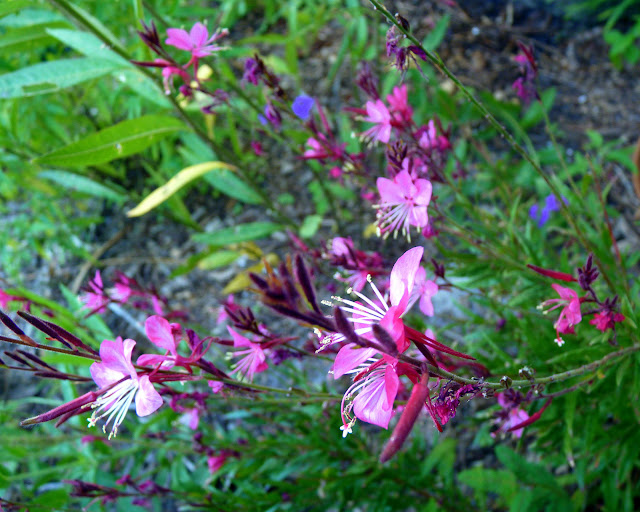
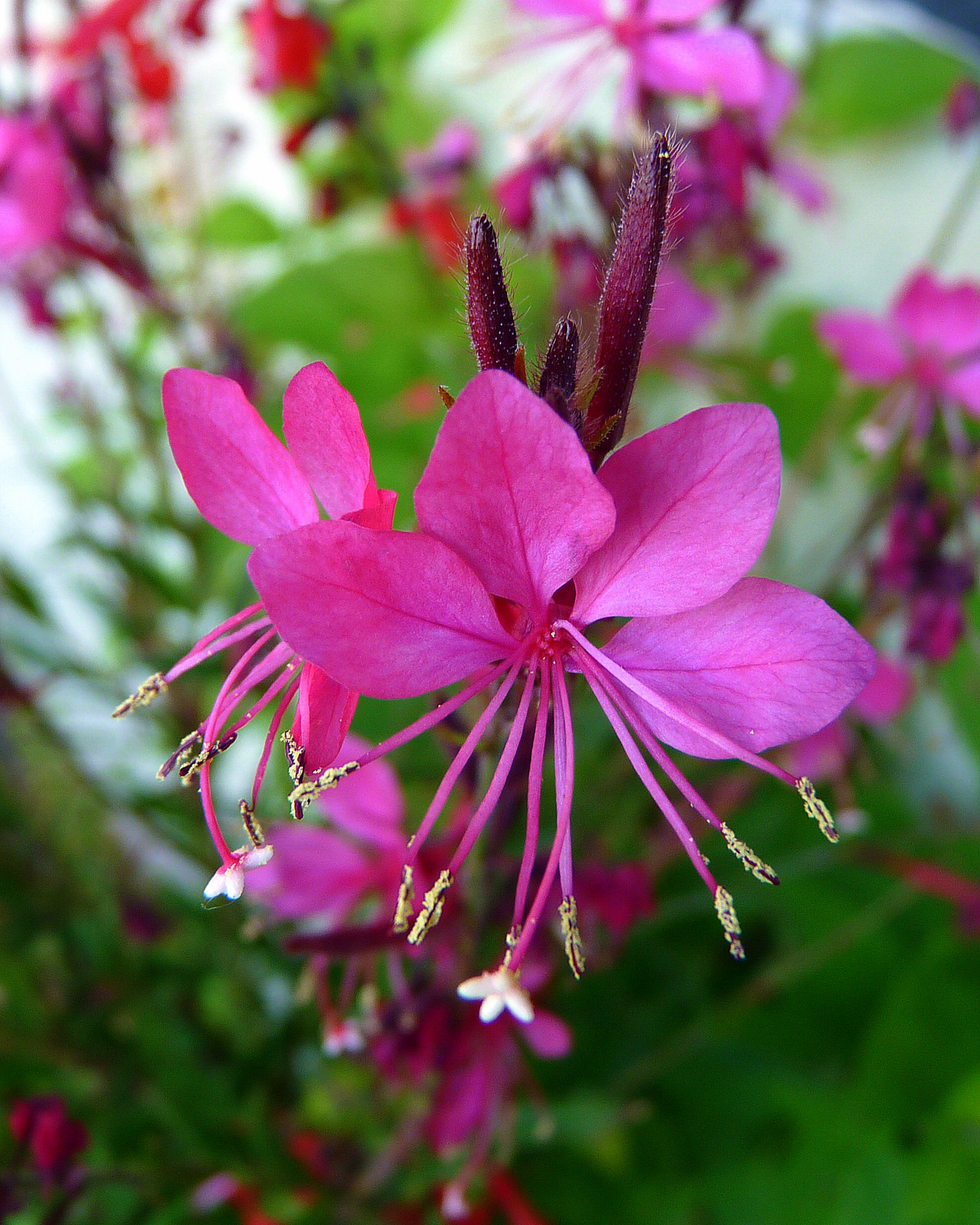
Gaura is native to Florida, although this particular variety ('Whirling Butterflies') has been hybridized to create a more compact plant with a greater number of blooms. The wilder gaura is wonderful too, and both have beautiful little flowers to admire up close.

Spring and its seemingly endless parade of new blooms never fails to amaze us in My Florida Backyard!

Gaura is native to Florida, although this particular variety ('Whirling Butterflies') has been hybridized to create a more compact plant with a greater number of blooms. The wilder gaura is wonderful too, and both have beautiful little flowers to admire up close.
Spring and its seemingly endless parade of new blooms never fails to amaze us in My Florida Backyard!
Sunday, May 8, 2011
Blanket on the Ground
We've been busy the last week or so... out-of-town guests, busy work schedules, and seemingly dozens of other things conspired to keep us from spending nearly as much time in My Florida Backyard as we would have liked. Fortunately, My Florida Backyard is perfectly capable of surviving and even thriving on benign neglect, and new blooms are popping up everywhere - not the least of which is the Blanket Flower.
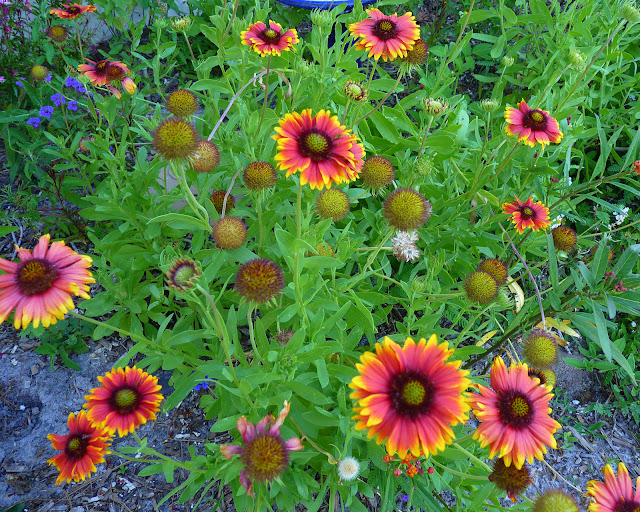
Indian Blanket (Gaillardia pulchella) is a wonderful native Florida wildflower. It asks for nothing but soil (sand will do), sun, and the occasional bit of rain, and rewards you with loads of cheery blooms for months on end. Then, it spreads its seeds, ensuring its return for years to come. In fact, all of our Gaillardia come from a single packet of seed we purchased for a couple of bucks a few years ago.

Gaillardia is great for pollinators and a natural in a wildflower garden. You'll often find it along roadsides and in wildflower meadows, and anywhere native flowers are emphasized. It does well in containers and is even salt-tolerant, so it's really perfect just about anywhere in this great state of ours.

Now that we've had a chance to slow down and admire what My Florida Backyard has been up to recently, we look forward to catching up a little more. Look for more posts in the days ahead on what our garden's been doing while we've been looking the other way!

Indian Blanket (Gaillardia pulchella) is a wonderful native Florida wildflower. It asks for nothing but soil (sand will do), sun, and the occasional bit of rain, and rewards you with loads of cheery blooms for months on end. Then, it spreads its seeds, ensuring its return for years to come. In fact, all of our Gaillardia come from a single packet of seed we purchased for a couple of bucks a few years ago.

Gaillardia is great for pollinators and a natural in a wildflower garden. You'll often find it along roadsides and in wildflower meadows, and anywhere native flowers are emphasized. It does well in containers and is even salt-tolerant, so it's really perfect just about anywhere in this great state of ours.

Now that we've had a chance to slow down and admire what My Florida Backyard has been up to recently, we look forward to catching up a little more. Look for more posts in the days ahead on what our garden's been doing while we've been looking the other way!
Subscribe to:
Posts (Atom)